
A shipment rarely breaks in one dramatic moment. It breaks slowly: a pallet corner under load for three weeks, a humidity swing on a long sea crossing, a carton that slides two centimetres every time a forklift turns. By the time the container opens, the damage looks like bad luck. It is almost always physics.
Smart lock shipping damage prevention is packaging engineering, and it starts by naming the enemy. Four forces account for most of the harm done to a lock order between the factory and the warehouse — and a serious packaging system has a specific answer to each one.
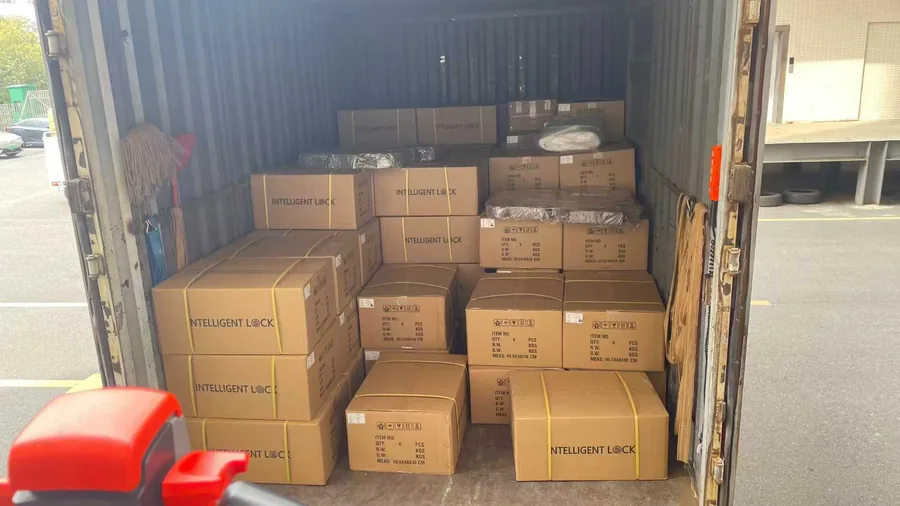
The four forces a carton has to survive
| Force | What it does to a lock shipment | What answers it |
|---|---|---|
| Moisture | Condensation and humid air reach electronics and metal finishes | Sealed inner protection, dry packing practice, moisture-aware cartons |
| Compression | Cartons at the bottom of a stack deform; corners crush | Rated carton board, correct stacking limits, unit-level structure |
| Vibration | Road and rail movement shakes products inside their boxes | Inserts that hold the lock and its parts in place |
| Handling | Drops, forklift contact, rough pallet moves | Clear marks, pallet discipline, loading that cannot shift |
Most quality complaints that sound like manufacturing problems trace back to one of those four. That is why the best time to think about them is at the packing line, not at the claims desk.
Moisture: the quiet damage
Water does not need a leak to cause trouble. A container crossing climate zones experiences large swings in temperature and humidity, and warm, damp air that cools inside a carton can condense on metal surfaces — a finish question at best, an electronics question at worst. Locks that travel with batteries and circuit boards deserve more respect than a plain cardboard box.
The answers are unglamorous: an inner barrier layer around the unit, dry packing conditions at the factory, and cartons that tolerate humidity rather than softening in it. For electronic hardware, packaging is the first climate system the product experiences.
Compression and the stack above
In a packed container, the bottom carton carries a share of everything above it for the length of the voyage. Weak board and optimistic stacking turn that load into crushed corners, deformed sleeves and scratched units. The documented carton data matters here too — our deadbolt models ship 20 units to a master carton measuring 470 × 340 × 445 mm, with DS01 cartons weighing 18.4 kg and DS05 cartons 17.0 kg, numbers buyers can check against their own handling limits.
Good packing practice is boring on purpose: board rated for the load, a stacking pattern that keeps weight over the carton’s walls rather than its middle, and pallets that protect the corners that carry the stack.
Vibration, drops and sliding boxes
On the road, everything moves. Vibration is constant, and every stop-and-go moment invites the product to shuffle inside its color box. A lock that arrives with a loose battery cover, a scuffed panel or a key rattling against the front face has usually slid its way there. The fix lives in fit: molded trays, foam cradles and inserts that hold the unit and its accessories immobile.
Handling is the fourth force and the most human. A taped, clearly marked carton that cannot shift on its pallet survives forklifts far better than a loose stack. Stacking, securing and palletizing are part of the product’s journey, and buyers should look at photographs of them with the same attention as the spec sheet. We walk through the full sequence in how an export order gets packed.
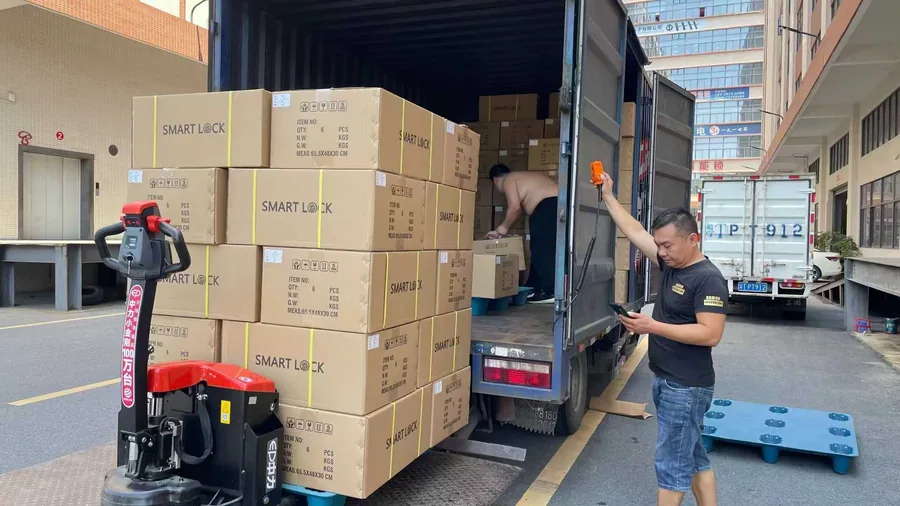
How packaging layers answer each threat
The system works like a set of nested answers, each one responsible for a different part of the journey:
- The unit layer — the product in its color box, held firm by an insert so nothing moves under vibration; on our deadbolt models the color box measures 225 × 162 × 85 mm with a unit weight of 0.91 kg for the DS01 and 0.83 kg for the DS05.
- The carton layer — a master carton of 20 units whose board strength and stacking pattern answer compression.
- The pallet layer — stable, corner-protected pallets that answer handling and keep loads from shifting.
- The journey layer — dry packing, honest marks and loading photos that make the whole chain inspectable.
No layer is glamorous. Together they are the reason an unopened carton from the other side of an ocean can be treated as a routine delivery instead of a gamble.
Carton data buyers should ask for
An importer who knows the carton numbers can plan warehouse space, handling equipment and container fill before the shipment lands — and can spot a problem the moment a carton deviates. Ask for the master carton dimensions and count per carton, the unit and carton weights, and photographs of the loaded pallet. Our deadbolt models — the DS05 among them — publish theirs: 20 units per master carton at 470 × 340 × 445 mm, with the weights noted above. The fuller list of questions worth putting to any supplier is in carton data for importers.
Those numbers also belong in the commercial documents, so that the carton that arrives can be checked against the carton that was ordered — which is exactly where smart lock shipping damage prevention becomes an inspection task rather than a hope.
What to do when a shipment arrives
Arrival is the last chance to catch transit damage early. Look at the pallet before it is broken down: leaning stacks, crushed corners, water staining and shifted loads are all evidence, and they are easiest to photograph before the forklift disappears. Then check counts against the packing list, open cartons from the middle of the stack as well as the top, and test a unit or two from different cartons rather than trusting the ones that happen to be accessible.
Document everything as you go, with photographs and carton numbers. A clear record protects the buyer, gives the supplier something to act on, and turns a bad carton into a fixed process instead of an argument. The full receiving routine is set out in our shipment receiving checklist.
Common questions
Can weather really damage a lock inside its box?
Humidity and temperature swings can, over a long journey — which is why dry packing and an inner barrier matter for electronic hardware — smart lock shipping damage prevention starts on the packing line. The lock is not waterproofed by its carton, but a well-built box keeps the climate the product experiences far gentler than the one outside it.
Who pays when a carton arrives damaged?
That depends on the terms agreed for the order and on the evidence collected at receiving. The practical answer for buyers is the same either way: inspect before signing, photograph everything, and report with carton numbers the same day. Terms and responsibilities are confirmed per order in the supply agreement, not assumed from a catalogue.
Is more packaging always better?
No — fit matters more than thickness. Excess packaging wastes freight and container space, while a carton that is strong but poorly filled lets the product move inside it. The best results come from layers matched to the four forces, each doing one job properly.
Shipping lock orders your customers will receive in good shape?
CaremLock supplies smart lock ranges to importers and distributors with documented carton data and photographable packing processes. Tell us your route and handling environment — we will share the packing and carton details your warehouse needs.
Or see the documented range on the DS05 deadbolt page and contact the team.