The front door gets the design budget, the smart lock and the family photographs. The back door gets the dog, the muddy boots and the recycling.
Most homes have more than one way in, but only one of them gets planned. The result is a house with a carefully designed main entrance and an improvised second one — which works fine until a family tries to make front door back door access behave as a single, coherent system, and discovers the two entrances have never been introduced to each other.
The asymmetry most homes live with
Walk around a typical house and the imbalance is obvious. The front entrance has lighting, a mat, maybe a camera doorbell or a smart lock, and clear rules about who uses it. The back door has a spare key under a pot and a habit of being left unlocked during garden afternoons.
The uncomfortable part is that the back door often carries more household traffic than the front. Family members come through it with groceries, muddy shoes and parcels. Contractors are pointed at it. The dog’s routine runs through it. The door that was designed least is used most — and when households think about securing “the entrance,” they are usually picturing the wrong one.
One household, one access logic
The first move is to stop treating the back door as an annex. If the front door has credentials, the back door should sit in the same system wherever the door conditions allow: the same family fingerprints or codes opening both, the same register recording who holds what, the same rule that household members never leave it unlocked “just while I’m in the yard.” Put differently: front door back door access managed as one system, not two households wearing the same address.
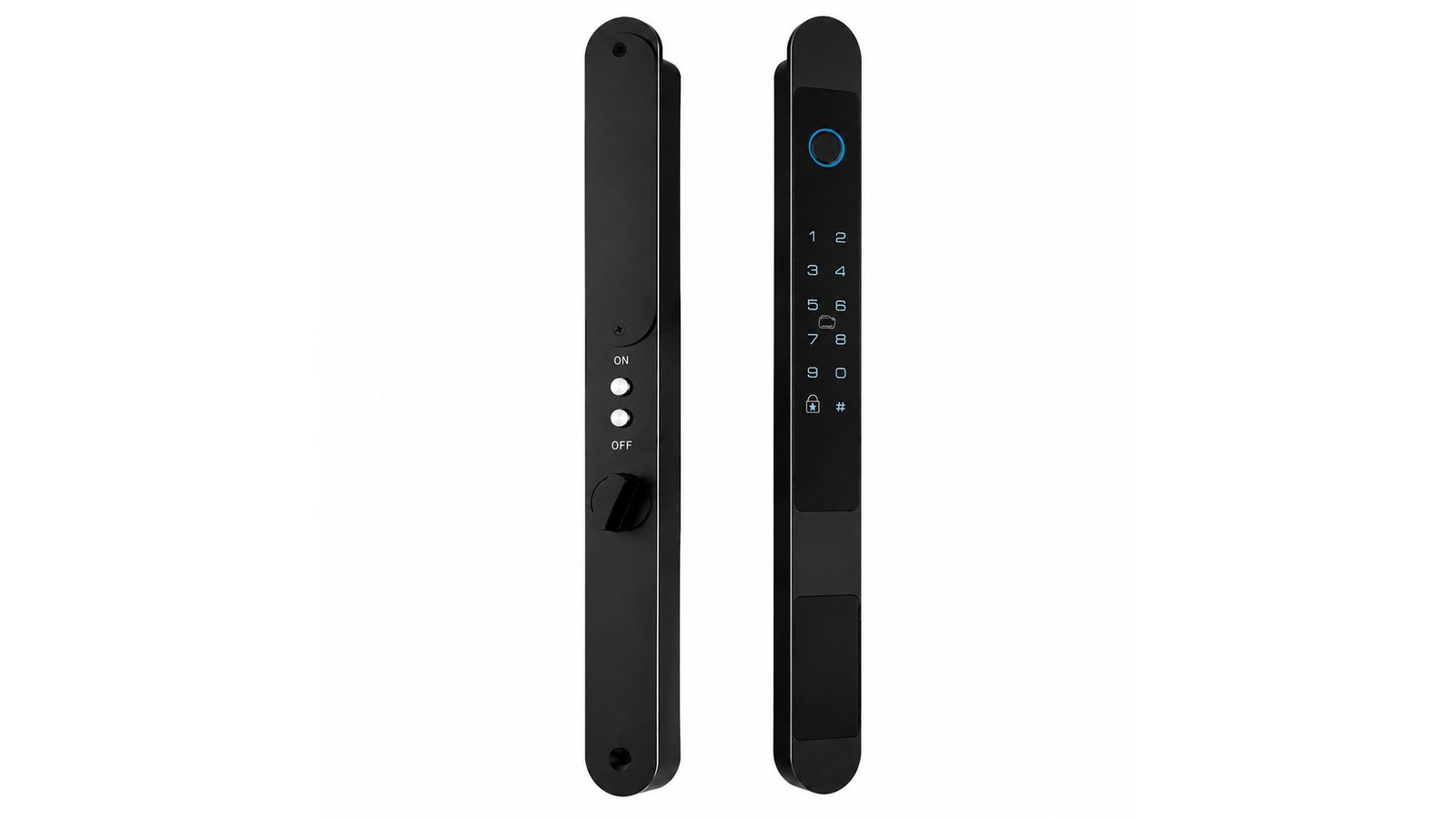
Our deadbolt models document exactly the kind of credential set that makes this easy: fingerprint, password, IC card and mechanical key on both DS01 and DS05, with capacity for up to 100 of each. The point of listing it that way is that on a two-door house, capacity is never the constraint — the constraint is discipline. One written register covering both doors, updated whenever someone joins or leaves the household’s orbit, does more for security than any single hardware upgrade.
Where the two doors genuinely differ
Treating both entrances as one system does not mean treating them as identical. Their jobs are different, and the differences should survive in the household’s routines:
- The front door is a presentation door. Its audience includes people who will use it once — a delivery driver, a guest’s plus-one, a contractor. Whatever access method it uses has to be explainable at the doorstep in under a minute, or it becomes a phone call.
- The back door is a repetition door. It is used by the same few people, many times a week, often with full hands. Speed and reliability matter more than explanation. This is also the door where a leftover “spare code shared with everyone” does the most quiet damage.
- Its exposure differs. The typical back entrance is hidden from the street, which changes the risk picture but not the rule: an unlocked back door is an unlocked house, no matter how private the yard feels.
Measure both doors before ordering hardware
Two-door households generate most of the compatibility surprises, because the entrances were often built or renovated at different times. Before ordering, measure both: door thickness matters most, and our deadbolt models fit doors from 35 to 55 mm, with DS01 covering wood, metal and plastic doors and DS05 covering wood and metal. Lock tongue options are documented at 60 and 70 mm, and DS01 follows standard North American door preparations.
Then check the things a tape measure misses: whether the back door still closes cleanly (old, swollen doors are common at the rear of a house) and whether its frame has shifted with the seasons. We cover both topics in checking a door’s compatibility and the installation preparation walkthrough, and the rear door of an older home is exactly where the advice earns its keep.
The season the back door becomes the main door
Household front door back door access habits move with the calendar. In garden season the back entrance can take most of a family’s comings and goings; through a cold month it may barely open at all. Holiday periods swing the traffic back to the front, with guests and deliveries. The doors themselves don’t change — but their share of the household’s attention does.
That makes a seasonal review worthwhile: check the hardware on both doors at the same time, confirm both still lock smoothly, test the mechanical key on each, and refresh any temporary codes issued for summer work or holiday stays. A short checklist for the wider version of this routine lives in seasonal entry readiness.
The two-door household audit
Run this once, then repeat each season
- Lock test: unlock and lock both doors from outside and inside, and confirm the bolt engages fully on each.
- Credential census: name every person with access to each door and which credential type they hold. Correct the register on the spot.
- Key check: locate the mechanical key for both doors — actually hold it — and confirm at least one adult outside the household knows where it lives.
- Weather check: watch how each door closes after rain or temperature swings; sticky latches are a maintenance note, not a security feature.
- Habit check: ask the honest question — when was the back door last left unlocked while the house was occupied but the yard was empty?
Questions from two-door households
Do both doors need the same model?
Not necessarily. The DS01 and DS05 are close siblings — same credential set and capacity — but they differ in door material coverage and in some panel and weight details, which is documented on their product pages and in the series overview. What should match is the household’s access logic; the hardware can differ where the doors do.
Can one credential open both doors?
It depends on the platforms you choose. Where both locks sit inside one management system, a single credential can be issued for both; where they run independently, each lock keeps its own user list — which still works, as long as the household register stays honest about the two lists. Check the platform documentation for the models you are considering before assuming either way.
What about the garden gate?
Gates are their own category: fully outdoors, different framing, different weather exposure. Rather than forcing a door lock into gate duty, keep the gate on a conventional lock and let the two entrance doors carry the credential system. Extension of access logic should follow the hardware’s documented scope, not the other way round.
Equipping homes with more than one entrance?
CaremLock supplies deadbolt and room-door ranges to distributors, installers and project buyers. Tell us the door profile — material, thickness, traffic — and we will outline the models and options that fit both entrances.
Or explore the deadbolt smart lock range and contact the team.