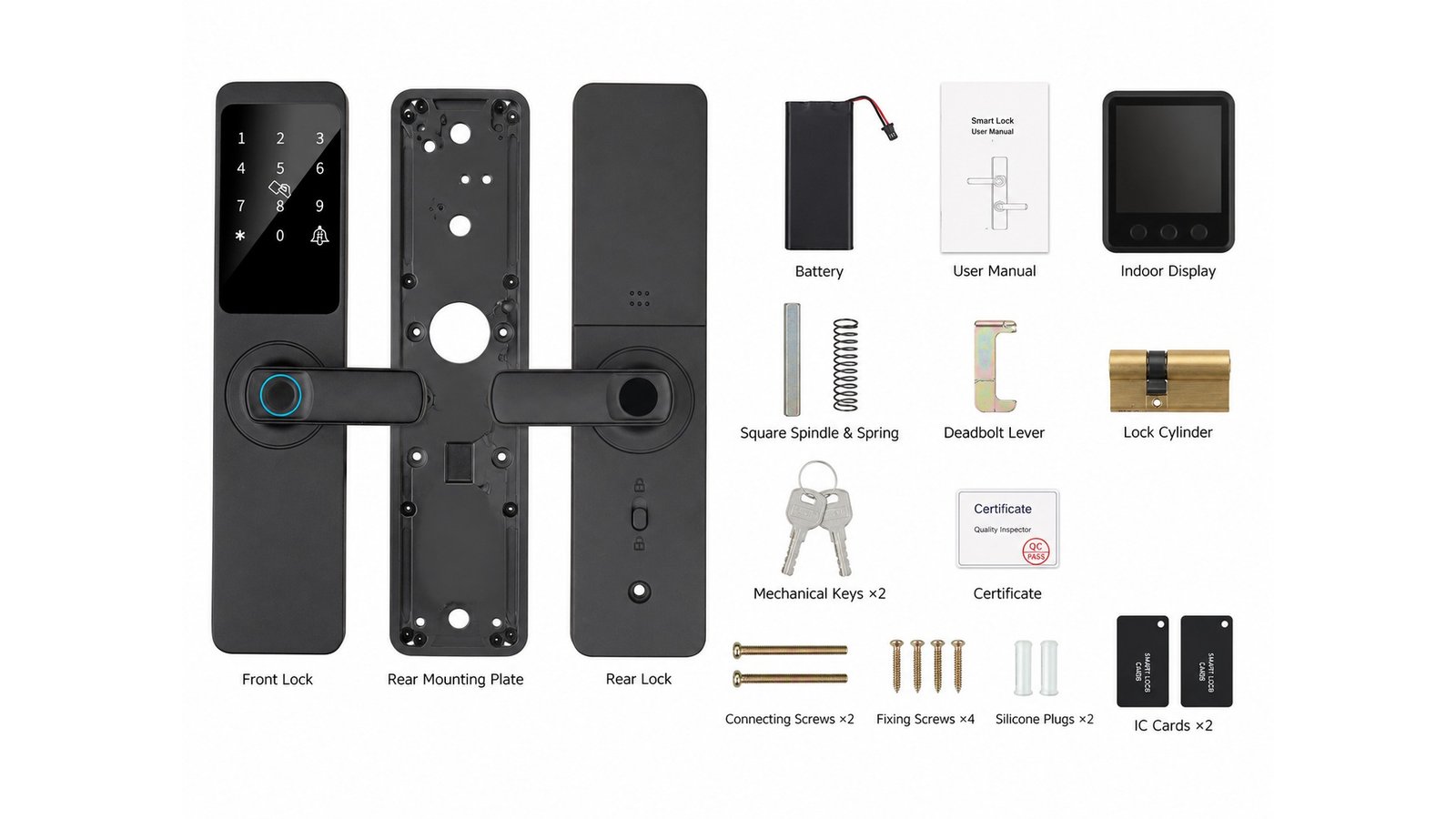
The first shipment lands on a Tuesday. It clears customs, reaches the warehouse, and sells — and by Friday, the support questions have started. Not the dramatic kind: a customer cannot find the manual, an installer wonders which spare fits which model, a buyer asks how to order one replacement part. None of these is a crisis. Together, they decide whether the first month of a new product line feels controlled or chaotic.
Smart lock after sales support is mostly preparation done before the shipment arrives. This is a working plan for distributors: what to have ready, how to route the first questions, and why the quiet week after a launch rewards the work done in the quiet weeks before it.
The first-month question list
After-sales questions arrive in a remarkably predictable order. Knowing the list in advance is most of the work:
- Installation fit: “The door is thicker/thinner than expected — does the model still work?” Door thickness and preparation questions cluster in the first days, while installers are still learning the product.
- Pairing and setup: app pairing, code creation, voice language selection, and how the first administrator credential is set.
- Daily-use confusion: what the prompts mean, how to add a family member, how to change a code the previous tenant may have known.
- Power: what battery the model takes, where to buy it, what the low-battery indication looks like, and how the mechanical key works as a backup.
- Spares and accessories: an extra key, a mounting screw, a replacement card — small parts that generate outsized friction when unavailable.
That list maps directly onto a preparation checklist. Everything on it can be answered before the first unit ships.
Documentation: decide who holds the manual
The cheapest after-sales infrastructure is a document. Product documentation is available through our Download Center, which gives distributors a single place to pull the files their own customers will ask for — installation drawings, model details and the reference material that answers most first-month questions.
Two habits make that documentation useful rather than merely present. First, download the full set for each model you stock before the shipment arrives, not after a customer asks, so the files live in your own system and can be sent in your own template. Second, note which questions need a link and which need a sentence — installers read drawings; end users read three lines of text. A one-page “where to find what” sheet for your customer-service desk is worth more than a perfectly organized folder nobody opens.

Spares: decide the policy before you need it
Spare-part policy is where distribution support is won or lost, because it touches every other process. A customer whose lock is fine but whose key is lost does not want a policy discussion; they want to know how to order a replacement, and they want the answer to be simple.
There is no universal right number, and we will not invent one here — spare quantities depend on your market, your model mix and your service promise. What is universal is the decision itself: which parts do you keep on the shelf, which are ordered per incident, who pays for shipping on a goodwill replacement, and who handles the request — your team or the factory. Write the answers down, and the first month’s spares questions become routine rather than negotiable. Buyers who want to pressure-test these policies before ordering can use the question list in what to ask a smart lock supplier.
The two-name rule: for every model you stock, keep two answers on file — the product’s documentation location and the name of who at the factory answers technical questions for it. When the first customer calls, one of those two resolves almost every case.
Training the first line before the first call
Most after-sales frustration is a routing problem, not a knowledge problem. A customer-service agent who does not know the difference between a deadbolt and a room-door model will forward every question to an engineer, and the engineers will drown in basics by week two.
The first-line briefing that pays for itself
- Model map: one line per stocked model — what door it fits and its documented entry methods.
- Top five questions with model-specific answers, in the customer’s language.
- The battery story for each model: what it takes, where it lives, and how the mechanical key works as backup.
- The escalation rule: which questions go to the factory, in what format, with what information attached.
- The spares list: what can be sold separately and how to order it.
- The return path: what a buyer does with a genuinely faulty unit, and what happens next.
This briefing is also the cheapest product feedback loop you will ever run. The questions your first line hears in month one are your market’s real requirements talking — a note-to-supplier list that eventually shapes what you order next.
Receiving quality, revisited for support
After-sales readiness connects directly to intake discipline. A shipment whose units were counted, checked and stored carefully produces far fewer support cases than one that was rushed to the shelf, because problems are found at the dock instead of at the customer’s door. The routines in our guides to receiving a smart lock shipment and to transit damage and packaging belong in your after-sales plan, not just in your logistics folder — they are the first line of support.
The same is true of quality inspection. A documented check at intake — appearance, completeness, function — creates the baseline your team needs when a customer reports a fault, because you already know the unit’s condition at arrival.

Building the support promise you can keep
There is a temptation to publish an ambitious support promise before the first order ships. Resist it. A support policy is a contract with your own team as much as with buyers, and the first month is the wrong time to discover that response times, replacement terms or spare availability were aspirational rather than operational.
A defensible first version is modest and specific: here is how to reach us, here is what we need from you to help quickly, here is what we handle directly and what we route to the manufacturer. Then expand it as you learn. Our own role in that relationship is deliberately narrow and documented — logo customization is available on approved orders, product documentation is available via the Download Center, and delivery can be arranged for your market — while the first-line relationship stays where it belongs: with the distributor who sold the lock.
For buyers building the wider commercial picture — payment structure, order stages, customization depth — the OEM/ODM guide is the natural companion to this article.
Common questions
When should a distributor write the after-sales plan?
Before the purchase order, ideally; before the shipment arrives, at the latest. The checklist itself takes an afternoon — documentation, spares policy, first-line briefing, escalation route — and every item on it gets cheaper the earlier it is done.
What do end users ask about most?
Setup and daily use: how to add a person, how to change a code, what the prompts mean, and what the lock takes for power. These are documentation questions, so the distributor with the manuals already on file answers in minutes while others are still emailing the factory.
How do we handle a genuinely faulty unit?
With evidence and a path. Intake records establish the unit’s condition on arrival; the customer’s description establishes the symptom; the escalation route establishes who decides. Buyers who want to see how that process is meant to work can compare it with the wider quality inspection checklist used from factory floor to dock.
Launching a new lock line with support ready?
CaremLock supplies documented deadbolt, glass, aluminum and room-door ranges, with product documentation available through the Download Center and OEM/ODM programs for private-label buyers. Tell us what your market will ask, and we will make sure the answers ship with the order.
Or explore the full product range and contact the team.