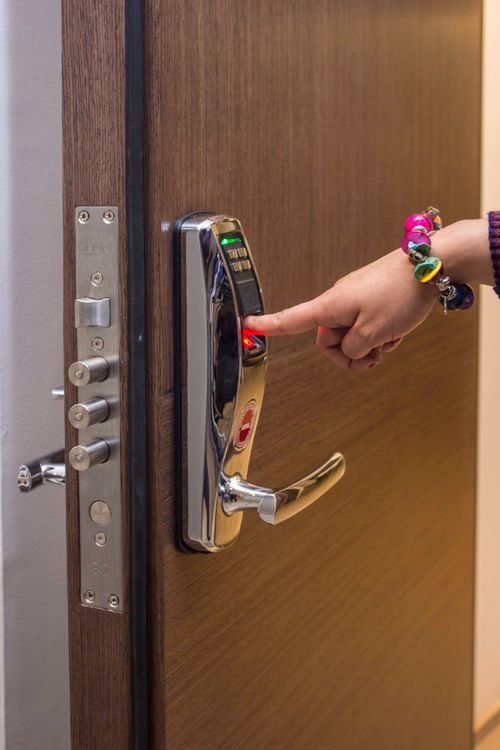
Direct answer: Saudi projects are different: the buyer will ask for written proof of each recognition method and each project feature before you quote, not after. So if you buy smart locks for a project in Saudi Arabia, check the unlocking methods first, then access management, then door fit, sample approval and support. Ask the supplier to confirm, in writing, which recognition methods the exact model supports, how many users each method supports, and how access is added, changed and removed. Ask for a sample, test it on the doors used in the project, and agree the approval steps before you quote. Do not promise a project buyer a feature the factory has not confirmed in writing for the exact model you will supply.
| If you… | Start with |
|---|---|
| Quote an apartment project | Written confirmation of face, palm, fingerprint and password methods, with user limits per method |
| Quote a hotel or office | Access management — who can open which door, and how access changes when a guest or employee leaves |
| Face a government or security brief | Written factory confirmation of each project feature (GPS, LTE, camera recording, tamper alerts) before you quote it |
| Need sample approval | A sample fitted on the exact project door profile, with a written test and approval record |
| Want your own brand | OEM terms agreed before ordering, including logo, packaging and app branding |
What should you ask about face recognition?
Face recognition is often the first feature a project buyer asks about, and it is also the feature that needs the clearest confirmation. Different models use different cameras, different enrolment steps and different limits, and a model that supports face recognition does not automatically support other methods. Ask the supplier to confirm, in writing, the exact unlocking methods for the model you will supply. For the DDL7 Fully Automatic Smart Lock, the published page confirms face recognition with a 2MP camera, contactless palm vein recognition for up to 50 palm-vein users, fingerprint access, and password and virtual password options. Those are the methods confirmed on the published page. Do not assume the same model also supports other methods unless the supplier confirms them in writing for that exact model. Useful reading on this site: distributor-range-evaluation and smart-lock-door-compatibility-checklist.
How should access be managed on a project?
Access management is the daily work of a project lock, and it matters more than any single feature. A project buyer will ask who can open which door, how access is changed when a tenant or employee leaves, and how a lost card or a forgotten code is handled. If those answers are unclear, the project will be hard to manage after handover. Ask the supplier how users are added and removed, how codes and cards are issued, and who can change access. Ask whether access can be managed by time or by door, and whether the system keeps a record of entries. Ask what happens when the internet is down, and whether the lock can still be opened with a fingerprint, a face, a palm, a code or a card. A lock that only works online is a risk for a project, because your customer will call you when the network fails.
What project features must be confirmed in writing?
Some government and security projects ask for features that are not part of a standard residential model. Those features must be confirmed in writing with the factory for the exact model, before you quote them. Do not quote them on the basis of a general claim, a catalogue photo or a conversation. In particular, confirm in writing with the factory whether the exact model supports GPS, LTE, camera recording, or tamper alerts. The DDL7 page does not confirm those features. It confirms face recognition with a 2MP camera, palm vein recognition for up to 50 palm-vein users, fingerprint access, and password and virtual password options. That is the confirmed list for DDL7 on the published page. GPS, LTE, camera recording and tamper alerts are not on that confirmed list, and they must be confirmed in writing with the factory before you promise them to a project buyer.
What should sample approval cover?
Sample approval is a project step, not a formality. It is your chance to find a problem before you order in bulk, and it is the step the project buyer will use to judge the range. When the sample arrives, fit it on a real door with the exact profile used in the project. Enrol a face, a palm, a fingerprint, a code and a card. Lock and unlock it many times. Test it with the app or management system, and test it without the app. Change the battery, and check how the low-battery warning works. Ask an installer to fit it, and ask how long the first fit takes, because that time is your cost on every door in the project. For a new range, start with a low-MOQ trial batch where the supplier offers one, to test fit, recognition, access management and support before you commit to a large order. Confirm the exact trial quantity, sample lead time, bulk lead time and warranty terms for the models you choose.
What about door fit, stock and support?
Door fit still comes before features, even on a project. Ask the supplier for a door compatibility checklist and a fitment list by model, with door thickness, backset, mortise size and handing. Test the sample on the exact door profile used in the project, including aluminium doors where relevant. A lock that does not fit cleanly will cost time on every door. Useful reading on this site: fingerprint-door-lock-oem-private-label-process and smart-lock-certifications-by-market.
A short checklist you can use
- Face, palm, fingerprint and password methods confirmed in writing for the exact model, with user limits
- Access management confirmed: adding and removing users, issuing codes and cards, and offline use
- Project features confirmed in writing with the factory, including GPS, LTE, camera recording and tamper alerts — do not quote them unless confirmed
- Sample fitted on a real project door by an installer, with a written test and approval record
- Door fit confirmed on the project door profile, including thickness, backset and mortise size
- Trial quantity, sample lead time, bulk lead time and warranty confirmed in writing
- Spare parts, support route and OEM terms agreed before ordering
If a supplier cannot answer one of these in writing, pause that model and ask again.
Next step
Pick two or three models that fit your main project door types, request samples and specification sheets, and test them on real doors with the people who will use them. Then compare them on the checklist above, not on catalogue photos. To request a quote, use the Smart Lock Quote Request form on caremlock.com or email sales@caremlock.com with your target models, quantities and customisation needs.
FAQ
What should a project buyer in Saudi Arabia check first?
The unlocking methods for the exact model, in writing, with user limits. Then access management, door fit, sample approval and support. Do not quote a feature the factory has not confirmed.
Does DDL7 support GPS, LTE, camera recording or tamper alerts?
Those features are not confirmed on the published DDL7 page. The page confirms face recognition with a 2MP camera, palm vein recognition for up to 50 palm-vein users, fingerprint access, and password and virtual password options. Confirm GPS, LTE, camera recording and tamper alerts in writing with the factory before you quote them.
How should access be managed when a user leaves?
Ask how users are added and removed, how codes and cards are issued, and whether the lock still opens without the internet. The answer should be clear for the project type you serve, whether hotel, office or apartment.
Can I start with a sample and a small trial order?
Yes, if the supplier offers a sample and low-MOQ trial batches. Confirm the exact trial quantity, lead time, warranty and sample approval steps in writing before you order, and use the trial to test recognition, access and support.