The first order is a transaction. The second order is the business. A distributor that adds a lock range is not buying a product; it is taking on a catalogue that has to fit several door types, answer counter questions, move through freight, and remain understandable after installation. A distributor smart lock range evaluation should predict that second order, not just the first.
The questions below are deliberately unglamorous. They cover support, power, credential limits, door fit, customization and carton data. None of them can be answered well by a brochure adjective, and all of them can be put in a comparison sheet before a sample is ordered.
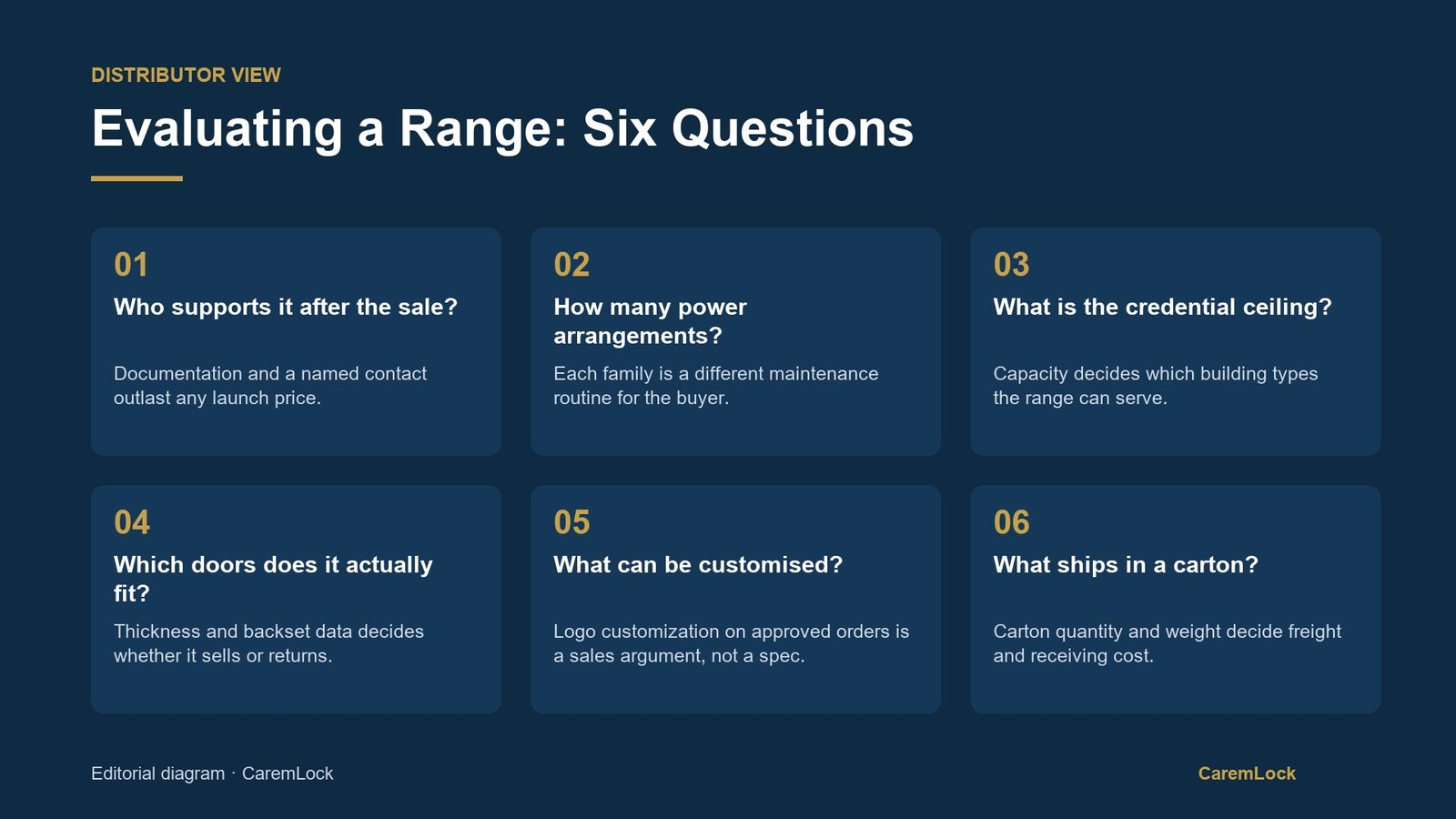
Six questions to settle before the first order
Ask the same six questions of every supplier. The point is not to find the longest answer, but to find the same kind of evidence in the same place for each model.
- After-sale support. What happens after the first installation? Ask what documentation, spare-part support and technical escalation are available, and who provides them. A distributor cannot absorb every installer question alone. Our notes on spare-parts stocking show why this belongs in the range decision rather than the first complaint.
- Power arrangements. What does each model use, and how many variants must the counter explain? A range with several power arrangements can be managed, but only with clear labelling and model-specific documentation. Mixed battery families on one site are a stock and training issue, not a footnote.
- Credential ceiling. What is the largest user count, and how many administrator positions exist? This decides which building types the range can serve without adding another supplier.
- Door fit. Which doors is each model documented to fit? “Most doors” is not a fit statement. Ask for the model-level statement, including door type and thickness where documented, and use the same reading method on every sheet; our guide to reading a lock spec sheet is built for that comparison.
- Customization. What can be branded, and under what approval? Logo customization is a confirmed capability on approved orders. Ask what the approval covers and do not assume anything beyond the logo until it is in writing.
- Carton contents. How many pieces per carton, what does each unit weigh, and what is the gross carton weight? These are inputs to freight, storage and receiving checks, not sales decoration.
Question 3 in detail: the credential ceiling
The credential ceiling is the quiet specification. It rarely leads a product page, yet it decides whether a range can quote a project without a second supplier. Two doors can look similar in a catalogue and carry very different populations: a small residential entrance versus a commercial door used by shift staff and contractors.
Documented examples make the point. The DS-series is listed at 100 fingerprints, 100 passwords and 100 cards. The DDL1 is documented at up to 297 users with 3 admin positions. Those are not interchangeable ranges, and the difference is not only capacity. The administrator count is a handover fact: who holds those positions, and what happens when a property manager leaves? A range evaluation should ask that of every model, because admin structure is part of support.
Build a simple list of target building types next to the user count each is expected to need. Then place each model against that list. If a model is close to its ceiling for a target building, the distributor is one staffing change away from a support problem. This is rough qualification, not a system design, but it prevents a range from being sold into buildings it cannot comfortably serve.
Question 6 in detail: carton quantity and weight
Carton data looks like logistics detail until the first freight plan or receiving day. The DS line is documented at 20 pieces per carton, with unit weights of approximately 0.91 kg and 0.83 kg and gross carton weights of 18.4 kg and 17.0 kg. The two figures belong to the documented line; ask which model or variant each applies to rather than averaging them into one convenient number.
Gross weight is an input, not a freight quote. It does not tell you carton dimensions, pallet pattern or the final cost of moving the range. Ask for the packing data for each SKU, because a range is rarely packed at one quantity across every model. If the evaluation sheet has a single packing row for the whole catalogue, it is hiding work that will appear later at the warehouse.
For a distributor, the useful number is not only “how many fit on a pallet.” It is “how many different carton profiles will my team have to receive, store and explain?” That count belongs in the same comparison as price and credential limits.
What good answers look like
Good answers are boring. They name a model code, a number, a unit, a document and, where relevant, a revision. They separate what is documented from what is still being checked. They do not turn a range-level promise into a model-level fact.
Weak answers are adjectives: strong, reliable, popular, complete. Those words may all be true, but they cannot be compared across suppliers or handed to an installer. If a supplier cannot produce a spec sheet or packing data for the exact SKU under discussion, treat that absence as the answer to the support question. A range without documentation is difficult to defend at the counter and harder to support after the sale.
CaremLock supplies smart locks for distributors, installers, integrators and project buyers. Documentation such as spec sheets and packing data is available on request. That does not remove the need for the six questions; it gives the distributor a source to check against them.
Build the evaluation sheet
Use three columns: the question, the documented answer, and the gap. The gap column is the one that protects the business. It records what the supplier has not yet confirmed, so a verbal assurance cannot quietly become a purchasing assumption.
Six rows, three columns
- After-sale support. Document what is available, who provides it and what remains unresolved. Put “we will support you” in the gap column until the scope is in writing.
- Power arrangements. List every arrangement by model and note where the counter would need two different explanations.
- Credential ceiling. Record users and admin positions separately. Compare them with the building types in your pipeline.
- Door fit. Quote the model-level fit statement, not the range summary. If there is no statement, the row is a gap.
- Customization. Confirm that logo customization applies to the exact order and record what approval is required.
- Carton contents. Enter pieces per carton, unit weight and gross weight for each SKU, then flag any missing packing dimension.
A completed sheet will not make a range decision for you. It will show which supplier answered the same questions with evidence and which one answered with confidence. That difference tends to become visible in the second order.
Building a lock range that has to sell twice?
CaremLock supplies smart locks for distributors, installers, integrators and project buyers, with factory-direct supply, in-house assembly and product testing, and model selection support for residential and commercial projects. Send the range brief and the questions you cannot answer from current documents, and our team will respond with the documented facts or mark the gap clearly.
Or review the product range and contact the team.