
7:40 in the morning. The elevator is coming, the coffee is in one hand, the work bag in the other, and there are exactly ninety seconds between the last look in the mirror and being late. This is the minute when a front door either works or loudly doesn’t — and it’s a completely different door than the one you use on a Sunday afternoon.
Most door hardware is designed around the calm version of you. The morning version is a different user entirely: hands full, mind on the commute, no patience for anything that has to be found, inserted, or remembered. This article is about that user — what makes an exit fast, what makes a lock invisible at 7:40, and why “did I lock it?” is the most expensive question of the morning.
The ninety seconds, in order
Watch anyone leave a house in the morning and the sequence is almost always this:
- The gather. Phone, keys, bag, coffee, maybe a child’s things. Everything gets picked up at once — which means both hands are now occupied.
- The pause. At the door, one hand has to be emptied to operate the lock. This is where bags get put down, coffee gets balanced, and time disappears.
- The lock. Locking behind you — or the mental check that it happened.
- The doubt. Ten steps down the corridor: did I actually lock it? For a lot of people, this costs a walk back or a low hum of uncertainty all the way to the station.
None of these steps is hard. Together they’re friction — and friction, repeated 250 mornings a year, is what a door redesign actually removes.
What makes an exit fast (from the hardware side)
Three properties decide whether a lock is fast in the morning:
The three properties
- It doesn’t need to be found. A key must be located before it can be used — in a bag, in a pocket, in yesterday’s jacket. Methods that carry nothing to find (fingerprint, code) eliminate the search step entirely. At 7:40, the search step is the expensive one.
- It works one-handed. Whatever the method, it must be operable with the bag still hanging from one arm — no laying things down, no two-hand operations.
- It reads as “done”. The fastest exit ends with certainty: you know it locked, without turning around. Whether that certainty comes from a voice confirmation, an indicator, or a habit built around exit-side operation matters less than the fact that it exists.
What about the door itself? News worth knowing if your building is older: doors that swell, stick, or need a shoulder in summer can force a wait even with the fastest lock — that’s an alignment problem, not a lock problem, and it’s exactly the kind of thing worth checking before blaming hardware. Our five-measurement guide covers door condition alongside fit.
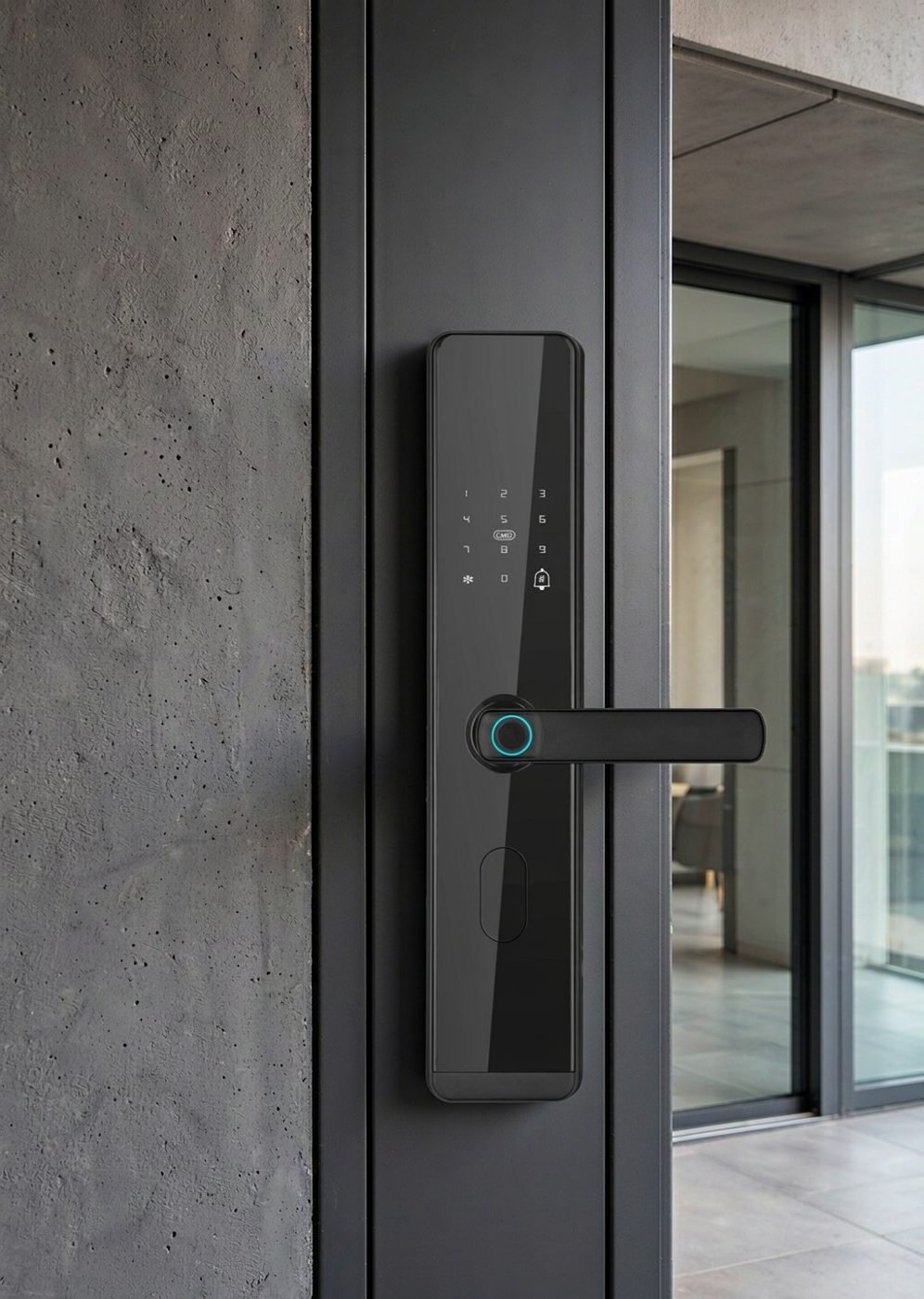
“Did I lock it?” — the question worth designing away
Of all the small anxieties a home produces, this one is uniquely repetitive: it recurs six days a week for decades. Households try to solve it with rules (“last one out locks”) and the rules fail exactly when mornings get chaotic, which is when they’re needed.
The design answer is to make locking something that happens around you, not something you remember to do. This shows up differently across lock types — and here we can only speak to what our own documentation states. The DDL1, for example, is documented as a fully automatic smart lock (its class of mechanism, not a marketing flourish — the lock body is motorised rather than requiring a manual handle action). If your morning routine depends on the “it locked itself” feeling, the product conversation to have is about mechanism class and documentation specifics for your model — ask us, and we’ll answer from the sheet.
The multi-user morning
The 7:40 door is rarely a single-user door. Somebody leaves at 7:10, somebody at 8:30, a child walks at 8:45, a cleaner arrives at 9. A lock that serves this rhythm well has one property above all: each person carries their own credential, so no one depends on passing a single key around, and no one’s change of schedule requires rekeying anything.
Our deadbolt pair, DS01 and DS05, states capacity for up to 100 fingerprints, 100 passwords, and 100 IC cards per lock — far more than a household needs, which is the point: every family member, plus the regulars, each on their own credential. When someone’s routine changes, their credential is removed, not the whole lock’s setup.
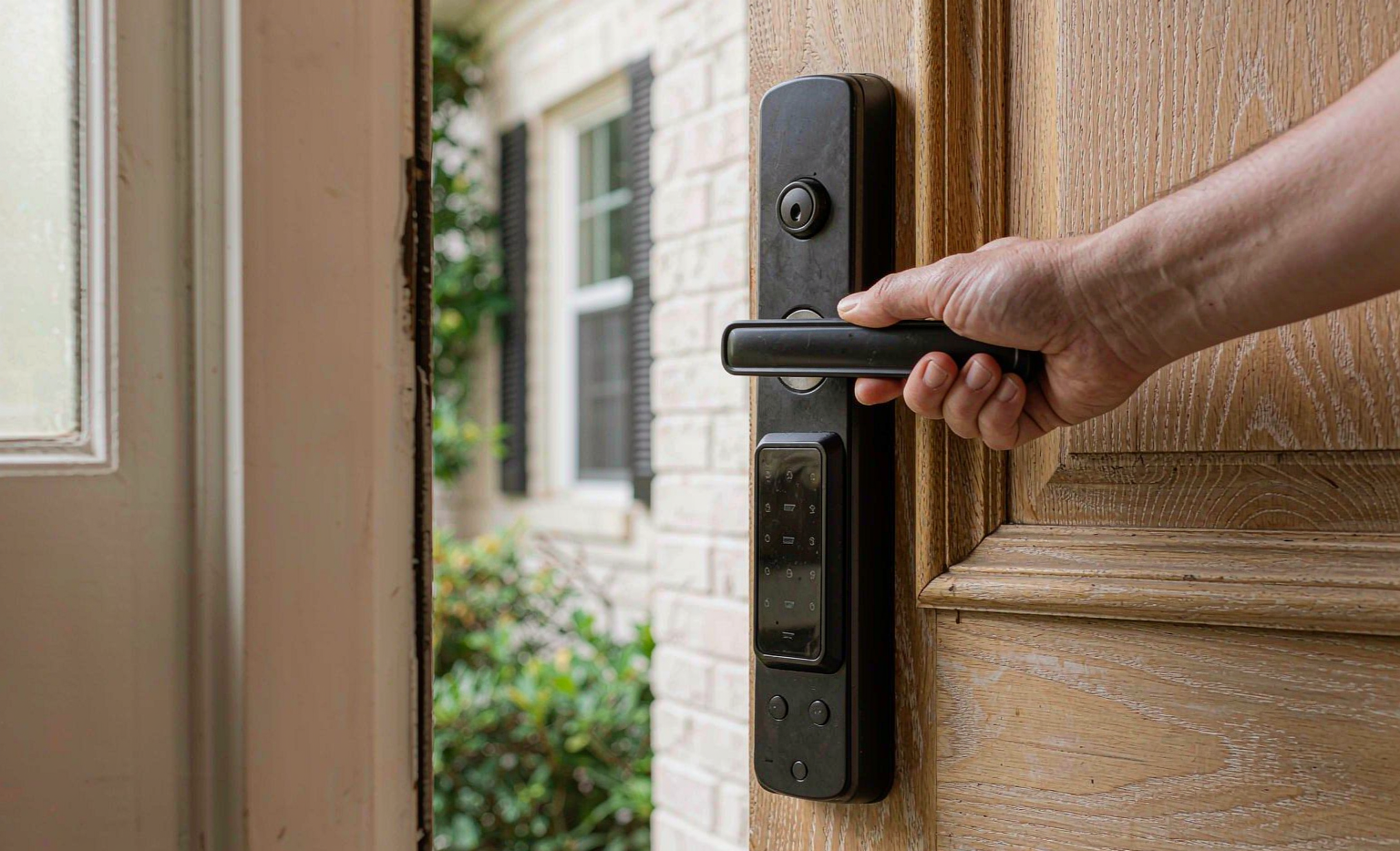
What we can verify in our own range
For fast morning exits, the models in our catalog designed closest to this use case:
- DS01 / DS05 deadbolts: fingerprint, password, IC card, and mechanical key; voice prompts in four languages (including a spoken confirmation you can hear with the door already closed behind you); 6 V AA power; 35–55 mm door thickness; DS01 for wood/metal/plastic doors, DS05 for wood/metal.
- DDL1 fully automatic: palm vein / face / fingerprint / password / IC card / key / app access — up to 297 normal users; 4200mAh battery with Type-C charging; 35–55 mm door thickness.
- DDA2 one-grip semi-automatic: dual-battery design with two sets of 4×AA and anti-reverse charging — the “one grip” name is about the exit motion itself.
And the honest boundary: no lock makes anyone punctual. What it removes is the search step, the two-hand juggle, and the doubt — three frictions out of four is a good morning.
Common questions
Does a smart lock make leaving faster, honestly?
For the departure flow, the measurable change is that the “find and insert” step disappears — you leave with a hand still full. For the return flow, it’s the reverse of the same thing. If your current routine has keys living loose in a bag, the difference is most noticeable in the first week.
What if the battery dies on a morning like this?
This is exactly why the mechanical key override exists and why every household should test it once — the emergency path, not the daily path. We wrote a full guide on the power question: what actually happens when the battery runs low.
Can one lock handle everyone’s different morning times?
Yes — that’s a credential capacity question, not a timing question. DS01/DS05 document up to 100 fingerprints, 100 passwords, and 100 IC cards. Assign each person their own, and morning changes become an admin detail, not a hardware problem.
Specifying locks for residential or multi-family projects?
Morning-flow performance is a real specification line for apartments, staff housing, and family rentals. Tell us your door mix and user count — we’ll outline capacity and configuration from the documentation.
Or explore the deadbolt range and talk to the team.