Monday, 8:40 in the morning. A caregiver lets herself into an apartment where an 84-year-old resident is finishing breakfast. Tuesday, the same caregiver comes at noon. Thursday, a cleaner arrives while nobody is home. Saturday, an adult daughter visits with groceries.
One door, five people, seven days — and none of them should have to meet at the doorstep to exchange a key. This is the quiet logistics problem that defines modern family caregiving: access that is generous enough to help, and precise enough to disappear when it isn’t needed.
Why key handoffs fail at scale
The traditional answer to “several people need to get into this home” is a set of copied keys. It works until it doesn’t, and it fails in predictable ways:
- Keys outlive the arrangement. A caregiver changes agencies; a cleaner stops coming; a key stays in circulation. Nobody intends this, but nobody tracks it either.
- Every key is an all-access pass. The key doesn’t know it was meant for weekdays between 9 and 11. If it’s lost, the household should assume it works until the lock is changed.
- The handoff itself is a scheduling job. Someone has to be home to give the key, and someone has to remember to collect it. That’s an errand that repeats indefinitely.
None of these are security melodramas. They’re just the ordinary costs of using a physical object as an access system for a rotating cast of people.
The credential model: one person, one key, revoked in seconds
The alternative model treats each person separately. Every member of the care circle gets their own credential — their own fingerprint, code, or card — and access is a list you can edit, not a metal object you have to retrieve.
Concretely, that changes the Monday-through-Sunday story:
How a typical care circle maps onto credentials
- The weekday caregiver gets a code or fingerprint of her own. When the agency rotates staff, you delete one credential and add the replacement — no locksmith, no key exchange, no visit.
- The adult children keep their own fingerprint or app access for visits and emergencies. Nobody borrows anyone’s key.
- The cleaner holds an IC card kept in her supply kit, or a code that’s live only on cleaning days if your lock’s platform supports time-limited access.
- The resident keeps the simplest method for her own daily use — often a fingerprint or a familiar code, with the mechanical key kept as the fixed emergency layer.
The numbers on our deadbolt models (DS01 and DS05) are worth a note here, because they show how much room this model actually needs: the documented capacity is up to 100 fingerprints, 100 passwords and 100 IC cards per lock. A care circle of five people isn’t stress-testing the hardware — it’s using a small fraction of it, which means adding the next person is routine rather than a negotiation.
What caregivers actually need at the door
Talk to people who visit homes professionally and the requirements are consistent:
- Reliability with full hands. Caregivers arrive carrying bags, equipment, sometimes meals. A method that works one-handed — a fingerprint or a short code — beats anything that has to be fished out of a pocket.
- A way in that doesn’t depend on a phone. Professional caregivers often can’t rely on installing an app for each client’s lock, and shouldn’t have to. Codes, fingerprints and cards work without any app at all.
- No guessing about whether it worked. When the lock confirms entry — a whispered prompt, a light, an audible click of the bolt — the caregiver knows the door is secure without testing it twice.
- A clean exit. Leaving matters as much as arriving: lock-up should be one motion on the way out, so the next person finds the door exactly as it should be.
Voice prompts are an underrated item on this list. Our deadbolt models document prompts in four languages — Chinese, English, Spanish and Portuguese — which matters in households where the resident and the caregiver don’t speak the same first language. A lock that talks is a lock that doesn’t need a translation card taped by the door.
The resident’s side of the same door
Everything above is about the helpers. The other half of the design is the person who lives there — and the principle is simple: the resident’s daily method should be the one they already find easiest, with the rest of the household working around it rather than the reverse.
In practice that usually means a fingerprint or a familiar short code for the resident, and we’ve written a fuller guide to those trade-offs in making entry work for older hands. The care-circle credentials live alongside, not on top.
A one-page access register: keep a written list — name, role, credential type, added date, and a note for removal. It takes five minutes to set up and turns “who still has access?” from a memory test into a lookup. Care agencies rotate staff; families forget; a page doesn’t.
Setting the boundary between access and supervision
One design line is worth drawing clearly for caregiving households: access management is about who can open the door. It is not a monitoring system. Whether your lock records entries depends on the platform version you choose, and if you use that capability, the honest approach is to agree with the resident what is checked and what isn’t.
Dignity is part of the specification here. A lock that treats its user as the owner of their own front door — with helpers as guests who hold credentials — is a different object from a system that watches. Families we’d describe as well-prepared tend to choose the first.
Where this fits in our own range
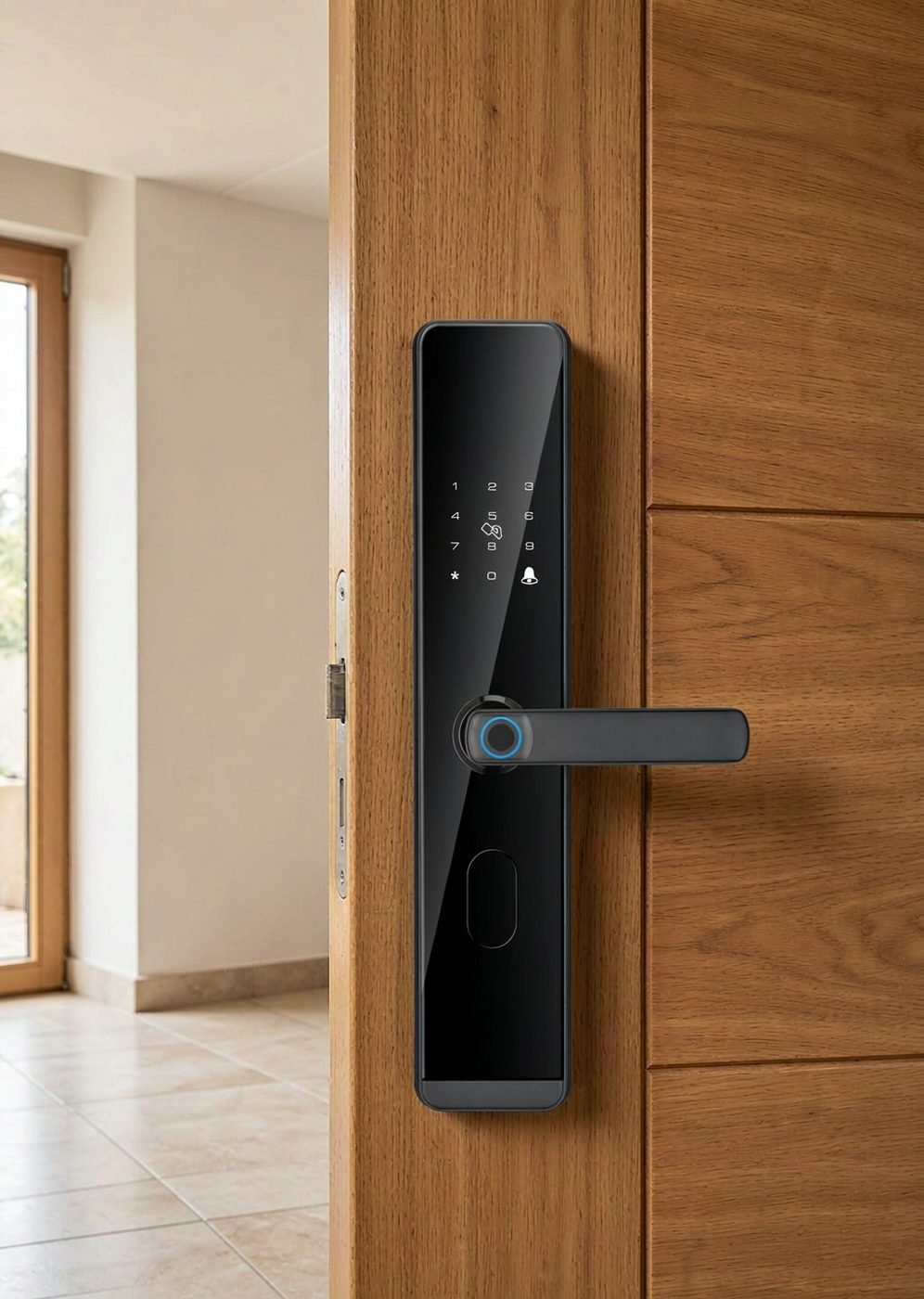
For caregiving households, the closest fit in our catalog is the deadbolt pair:
- DS01 and DS05 — fingerprint, password, IC card and mechanical key access; documented capacity of 100/100/100; voice prompts in four languages; 6 V AA batteries; door thickness 35–55 mm (DS01 for wood, metal and plastic doors; DS05 for wood and metal).
For a household setting this up, the practical sequence is: choose the resident’s method first, add helpers’ credentials one at a time, write them into the register, and test the full arrival-and-exit routine with each person once. Ten minutes per person now saves the awkward doorstep conversation later.
Common questions
Should the caregiver use a code or a fingerprint?
Fingerprints suit professionals who visit several homes a day — nothing to remember, nothing to carry, and it’s personal to them. Codes suit situations where a credential needs to be shared across rotating staff or handed over quickly. Many care arrangements mix both: the regular caregiver on fingerprint, the occasional substitute on a code that’s deleted afterwards.
What happens when the battery runs low?
The deadbolt models run on 6 V from four AA batteries, and the mechanical key always provides a way in. We keep the full routine — warning signs, spares, testing the key — in a dedicated guide: what happens when a smart lock battery runs low. For caregiving households, the extra step worth adding is making sure the caregiver knows the backup exists and where the key is kept.
Can a resident who isn’t comfortable with technology use this?
Yes, because the resident never has to touch the complicated parts. The app, the platform settings and the credential list are the family’s side of the system. The resident’s side is a finger or a four-to-six digit code — the same interaction as a bank card PIN. If you want the fuller picture, the elderly-focused guide linked above walks through the choices in detail.
Organizing access for home-care projects?
CaremLock supplies smart lock ranges for distributors, installers and project buyers working with family homes and care residences. Tell us the household or project profile — we’ll outline the models and credential approach from our documentation.
Or explore the deadbolt smart lock range and contact the team.