The manual is in a drawer, still in its bag, and the person at the door is on the phone. The lock is working exactly as documented. The problem is that the documentation lives somewhere the user is not: at a desk, in a folder, behind a login, or in a language the user does not read.
A door lock instruction card for tenants is a different artifact. It is not a condensed manual and it is not a policy notice. It is a half-page answer to the four questions a person asks in the first ten seconds in front of an unfamiliar lock. Done well, it prevents most first-line support calls. Done badly, it creates a new problem by putting information where it does not belong.
What the card has to answer in ten seconds
The card should follow the person’s sequence, not the product’s menu. Four questions come up in roughly this order.
- How do I open this door? A short sequence in plain language: what to present, where, and what happens next. Not feature names.
- What does this signal mean? Only the states a user will actually meet, defined from the model’s own documentation rather than guessed from memory.
- What do I do if it refuses? Two or three checks, then the documented alternative for the site, then the call.
- Who do I call, and when? A role, a number and the hours it is answered, plus the out-of-hours path.
Test the card by handing it to someone who has never used the door and watching where they hesitate. Every question they ask is either a missing line or a line that needs plainer wording. A card that requires a second explanation is not finished.
Three card versions for three audiences
One card cannot serve everyone. The same template can, with different depth.
- Tenant card. Daily use: opening, locking up, what to do when a credential fails, who to call. This card stays in place and is reviewed when the building changes.
- Guest card. Arrival, the first entry, checkout and one contact. It is temporary and should leave with the guest. Detailed building information does not belong on it.
- Service visitor card. Which entrance, how access has been arranged, where to report completion and who to call. It explains the process without exposing the means of entry.
The mistake is a single card for all three: it either tells a guest too much about the building or tells a cleaner too little about the door. Separate versions also make replacement easier, because each audience has its own print run and its own review trigger.
Guest-facing instructions have their own timing problem; the notes on guest arrival instructions cover what needs to be said before the person reaches the door.
What must never go on the card
A card is a map, not a key. It can tell someone which door, which sequence and whom to call. It must never tell them how to get in without a credential of their own.
That rules out entry codes, passwords, credential values, installer menus, wiring details and any step that bypasses the normal process. It also rules out personal information that is not needed at the door: a resident name paired with a unit number is a privacy problem even when it is helpful to a cleaner.
The test is simple. If the card is lost, the loss should cost a reprint, not a lock change. If reading it aloud would let a stranger enter, it has too much on it.
Write for the person who finds it, not the person who installed it. Installation detail belongs in the technical file. The card belongs to the user standing at the door.
Language on the card
Language is a design input, not a translation task at the end. The card should be written in the languages people actually read at that door, which may not be the languages the product offers.
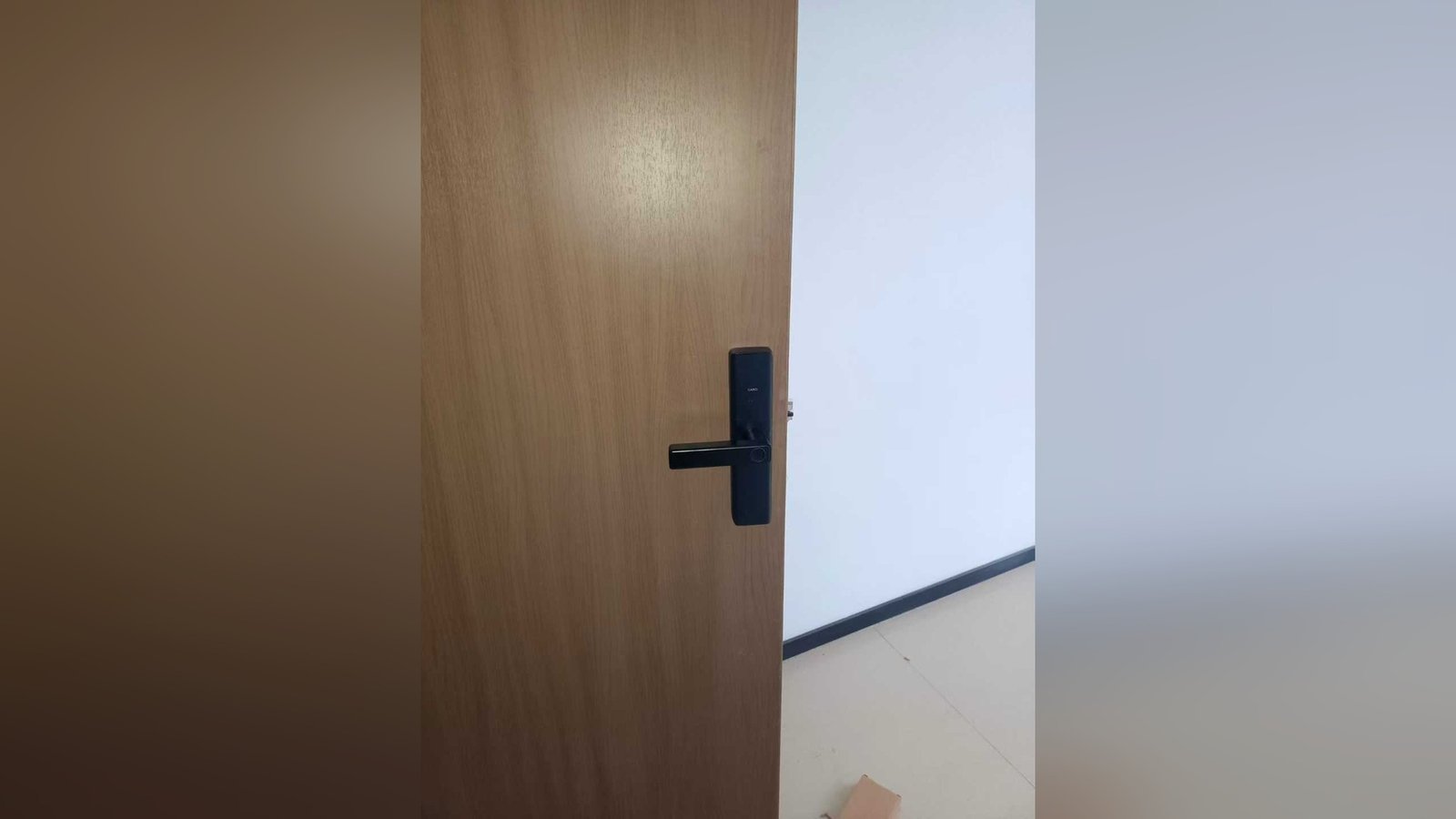
CaremLock documentation states that the DS-series deadbolts have voice prompts in four languages: Chinese, English, Spanish and Portuguese. The A20 glass-door model is documented with a nine-language interface. Those are product capabilities, and they are useful when the spoken prompt and the printed card need to line up. They are not a statement about the building. Documentation is available on request, so the language list can be checked before a card is designed.
Start with the languages spoken by the people who will use the door, not the languages in the catalog. Then decide how many versions to print. Two clean cards in two languages usually work better than one crowded card with four columns. Test the final text with a native speaker who is not the person who wrote it, especially the contact line and the failure instructions.
Voice and print are separate decisions. A person may read one language and hear another, and that is fine as long as the card does not promise a language the lock does not actually use. If the card says the lock will speak to you in Spanish, confirm that against the model documentation first.
Buildings with several household languages face the same choice at a larger scale; multilingual household entry covers how to keep one process while varying the language.
Designing the card
The physical card matters as much as the words. A correct instruction in the wrong place is still a support call.
What a working card needs
- Size and type: half a page, large enough to read at arm’s length, with the four questions in order.
- Placement: beside the door at eye level, visible before the handle, not behind it.
- Protection: a sleeve or frame if the door is exposed to weather; paper alone will not survive a season.
- Contrast: dark text on a light background, no decorative fonts and no dense paragraphs.
- Content: four questions, the contact line and nothing that functions as a credential.
- Version: a date and an owner on the back, so an old card can be recognised.
- Replacement: a named person, a spare stock and a review date.
- Consistency: the same template across the building, so a tenant who moves floors is not relearning the card.
A card is a living document. Doors change, contacts change and models change. Put the review date where the owner will see it, and replace the card when the underlying instruction changes rather than adding a sticker.
In multi-tenant buildings, the same discipline applies to shared entrances; shared office suite entries shows why one entrance can serve several audiences without one instruction sheet trying to serve all of them.
Writing instructions for a door you do not use every day?
CaremLock documents the voice-prompt languages and interface languages of its models so operators can match a card to what the lock actually does. Send the door list and the languages in use, and our team will confirm what the documentation states for the models on your list.
Or review the product range and contact the team.