A shared entrance between two households is a common arrangement with an uncommon problem at the front door. An elderly parent moves in with adult children; two friends buy a flat together; a lodger takes a room for a year; a sibling returns home after a separation. The hardware can be identical to any other entrance. What changes is that every entry decision now has two sets of expectations behind it, and no one has written down which set applies when.
This is not primarily a lock problem. It is a small governance problem that shows up as a lock problem: whose finger opens the door, who can add a cleaner, who answers when a delivery arrives, and who still has access after the arrangement ends. The practical work is to settle those questions before credentials are issued, then choose hardware with enough documented capacity to carry the answer.
The three decisions
Most shared-entrance friction comes from three questions that were never answered explicitly. They are easy to settle in a kitchen conversation and expensive to settle at the door with a visitor waiting.
Who belongs
Make the list of people, not the list of credentials. Each person should have a named credential owner, the household that vouches for them, and a method they can actually use. A partner who visits four nights a week and a cleaner who comes twice a month are different kinds of user, and the difference should be visible before enrollment. The list is also the record you will use when someone leaves.
Who admits visitors
This is the question nobody writes down. One household may prefer that each resident admits their own guests; the other may expect a single rule for the door. Either can work, but only one can be the default. Write the default down, including what happens when the person who normally answers is away. The failure mode is not a security breach; it is two people giving a visitor different answers at the same door.
Who holds admin
Administration is a role, not a reward for being the person who bought the lock. The DDL1 documents 3 admin positions, enough to give each household a primary administrator and keep one shared position for the person who maintains the list. Decide who can add, remove and change credentials, and decide what happens if that person is unavailable. Our notes on admin role structure treat this as a small access-control design rather than an afterthought.
Credentials per household, not per door
The useful mental model is a register per household, held against one door. Each household knows its own people, its own guest rule and its own review date; the door holds the combined list.
Capacity determines whether that model is practical. The DS-series deadbolt documents 100 fingerprints, 100 passwords and 100 cards, plus a mechanical key override; the DDL1 documents up to 297 users with 3 admin positions. For two households, those figures offer headroom, but headroom is not the same as organization. If each resident enrolls a finger, a code and a card, the slots fill three at a time. Keep the register by person and method, and treat a spare credential as a decision rather than a convenience.
The mechanical key override deserves its own line in the register. It is a backup for the door, and a backup is only useful if both households know where it is and who may use it. A key that lives with one household and is unknown to the other is not a shared backup; it is a private advantage. Shared entrances also carry long-term costs beyond the purchase price, which is why the total cost of ownership view is worth taking before the model is chosen.
The visitor problem
Visitors are where a shared entrance shows its weak point. Residents can be enrolled once; visitors arrive without notice, stay for a fixed period and should not leave a permanent credential behind. The operational answer is a temporary credential with an expiry, issued by a named person and recorded in the register.
Temporary access is documented in the range rather than assumed across it: the DDZ17 room-door model documents 300 users and temporary passwords. The point is the pattern, not the model: access that ends without anyone having to remember to revoke it. If a shared entrance needs that pattern, ask which entrance models document temporary access and how expiry is set; do not carry the assumption across from a room-door product. The rule should also say who may issue a temporary credential and who confirms it has expired.
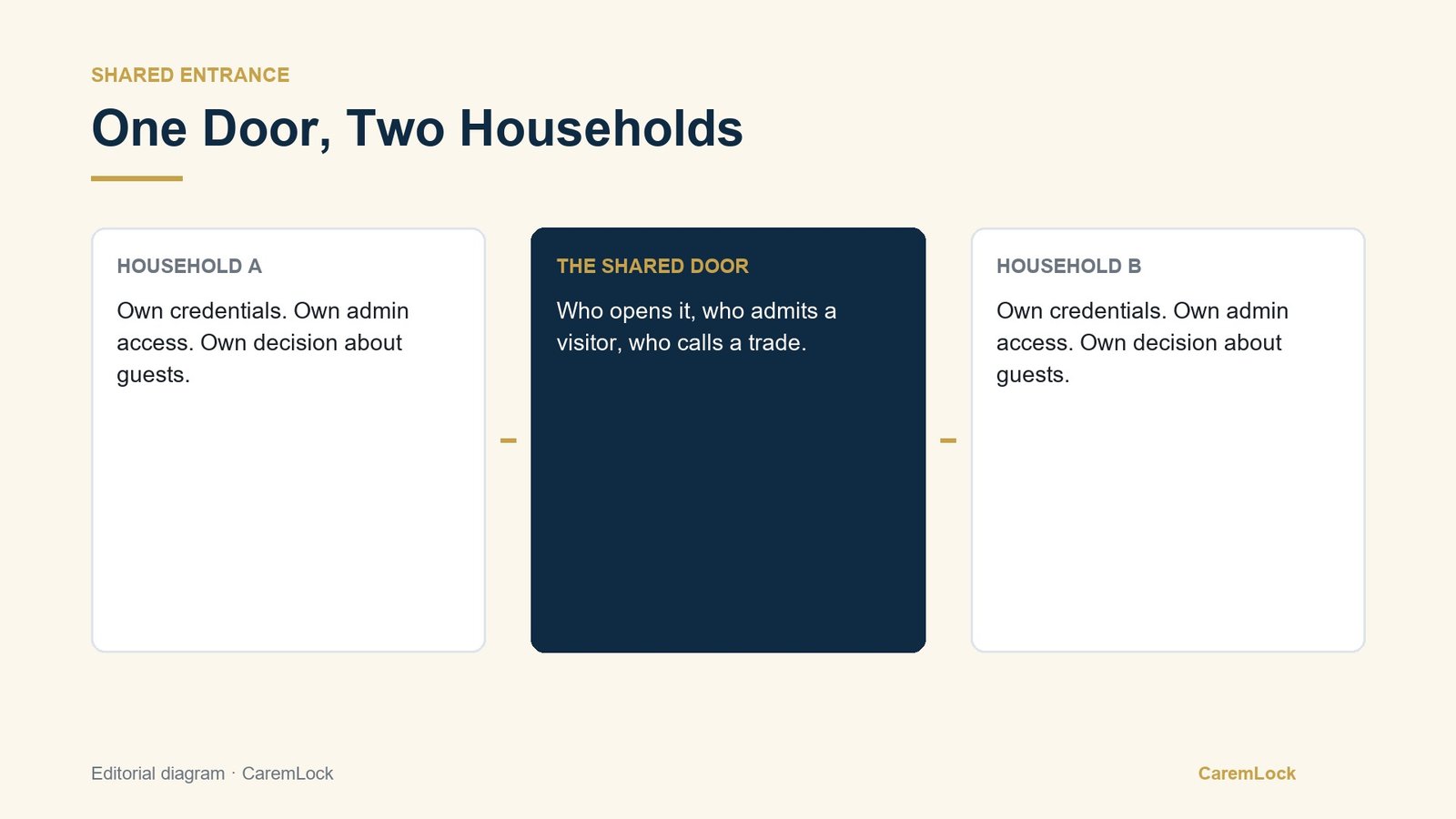
The agreement
Put the arrangement on one page. It does not need to be legalistic; it needs to be specific enough that two households can apply it the same way.
What the page should cover
- Credential owner per person. Name, household, methods issued, and date.
- Guest rule. Who may admit a visitor, how long a visitor credential lasts, and who issues it.
- Trade rule. Cleaners, carers and contractors: named person, named household, review date.
- Exit rule. What is removed when a person leaves, and who confirms it.
- Review date. A fixed date to check the list, not a vague promise to review it.
The door does not know which household is which. It only knows the credential presented. That is why the register, not the lock, is the source of truth for who belongs. The hardware enforces the list; the households have to agree on the list.
When the arrangement changes
The same register that issued a credential should revoke it. When someone moves out, the exit rule runs: remove their fingerprint, password and card, check whether they held a temporary credential, and confirm the admin list still has a reachable person from each household. If the door is being handed to a new occupant, treat the handover as a fresh start rather than an edit; our installer handoff packet is a useful model for the record because it forces the practical details, including key custody and credential status, into one place.
Arrangements also change without anyone moving: a lodger becomes a partner, a carer’s hours increase, a student returns for the summer. A fixed review date catches those changes before they become assumptions. The test is simple: can each household name every person who currently has access, and say why? If the answer takes a phone call to establish, the register has fallen behind the door.
Common questions
Do both households need admin access?
Not necessarily, but each household needs a named route to one. The DDL1 documents 3 admin positions, enough for a primary administrator per household plus a shared maintainer if the list is kept current.
What happens to a lodger’s access when they leave?
The exit rule applies: remove every method issued to that person and confirm the removal against the register. A credential that is forgotten is still a working credential.
Planning access for a shared entrance?
CaremLock supplies documented smart locks for distributors, installers, integrators and property buyers. Our team can confirm capacity, admin positions and the available documentation for the models you are considering, and specification sheets are available on request.
Or review the product range and contact the team.