
It’s a little after four in the afternoon. A school bus stops two streets from home, and a child walks the last stretch alone. Somewhere across town, a parent is still in a meeting, watching the clock without really watching it.
For a lot of families, this is the most rehearsed moment of the week that nobody has actually rehearsed. The front door is the handoff point — and it is usually managed with one of three things: a spare key hidden somewhere outside, a key on a string around a small neck, or a fair amount of hope. This article is about that handoff: what actually causes trouble, what a smart lock changes, and what it takes for a child to be the first one home without anyone worrying about a key.
The parts nobody rehearses
Ask parents what went wrong with “the key situation” and the same four problems come up again and again.
- The hiding spot isn’t hidden. Everyone knows the flowerpot, the meter box, the ledge above the door. So does anyone who has ever waited outside the house for five minutes. A spare key that lives outside is not a spare key; it’s an unmonitored entrance.
- Keys get lost between places. School bags, sports gear, the bus, the friend’s house. Every lost key is a small logistical crisis and, at minimum, a lock that should be rekeyed for peace of mind.
- The door gets left open. Not maliciously — distractedly. A child comes in with a backpack, a jacket, a phone in one hand, and the door stays on the latch. Half the point of a lock is the part that happens after the door closes.
- Nobody knows when “home” happened. The worry gap between “bus should have arrived” and “I can finally call to check” is its own kind of stress, and it’s the part families describe most vividly.
Notice that three of these four are not “security” problems in the dramatic sense. They are logistics problems — small, daily, and completely ordinary. That matters, because it tells you what kind of solution to look for.
What changes when the lock changes
A smart lock doesn’t make decisions for a child, and it doesn’t replace a family’s routines. What it can do is remove the part of the routine that depends on a carried object.
With keyless access, the daily question stops being “do you have your key?” and becomes “which method does this child actually use well?” That’s a much better question, because the answer is different for a six-year-old, a twelve-year-old, and the grandparent who picks them up on Fridays.
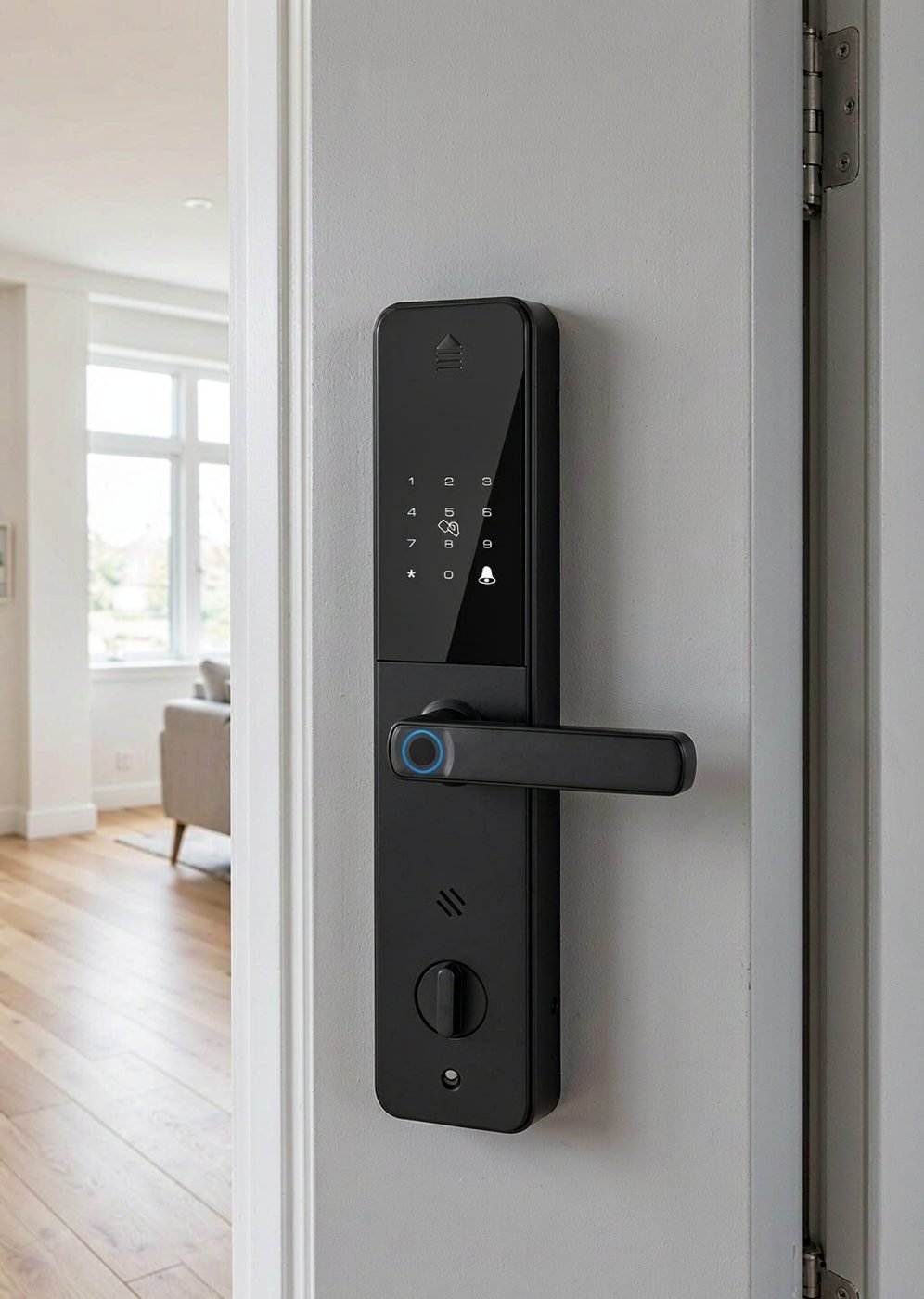
Choosing an entry method a child will actually use
Most smart locks for homes offer several ways in. They are not interchangeable, and the right one depends on the person and the door. A short, honest walkthrough:
Four access methods, four trade-offs
- Numeric code. The most universal option — no object to carry, no phone needed, works the same on the way out as on the way in. The trade-offs are human: codes get shared too casually, and young children may need practice to enter six digits calmly at the door instead of in a hurry.
- Fingerprint. Nothing to carry, nothing to remember. But fingerprint readers are typically engineered around adult fingers, and some children’s prints can be harder for sensors to read reliably. If a child will rely on fingerprint entry, test it with them during setup — on a calm day, not during the first rushed afternoon — before making it their primary method.
- IC card. Works like a bus pass: it lives in a bag pocket and taps the lock. It can still be lost like a key, but it’s easy to understand for almost any age and easy to hand over to a grandparent or a regular visitor.
- Smartphone app. Powerful for older users, but most families find that a code or a fingerprint is the more reliable daily method for children who don’t carry a phone yet.
In practice, most households end up with a layered setup: the child uses a code or a card, the adults keep a fingerprint and the app, and the mechanical key stays where mechanical keys belong — as an emergency backup, not part of the daily routine.
The backup question — the part parents skip
Every electronic lock has one thing in common with every other electronic device: it runs on power, and one day that power will be low. That’s not a defect; it’s physics. What separates a good experience from a bad one is whether the backup path is planned before it’s needed.
Before a child relies on any lock every day, answer these three questions together:
- How is the lock powered — replaceable batteries or a rechargeable pack? Where are the spares kept?
- What is the mechanical override, and where is that key kept? (Not in a hiding spot outside, and not inside the house.)
- Who is the adult a child can call, or walk to, if the door doesn’t open and no one is home yet?
That third question is the one families report being most glad they discussed. The lock is hardware; the plan around it is what makes it dependable.
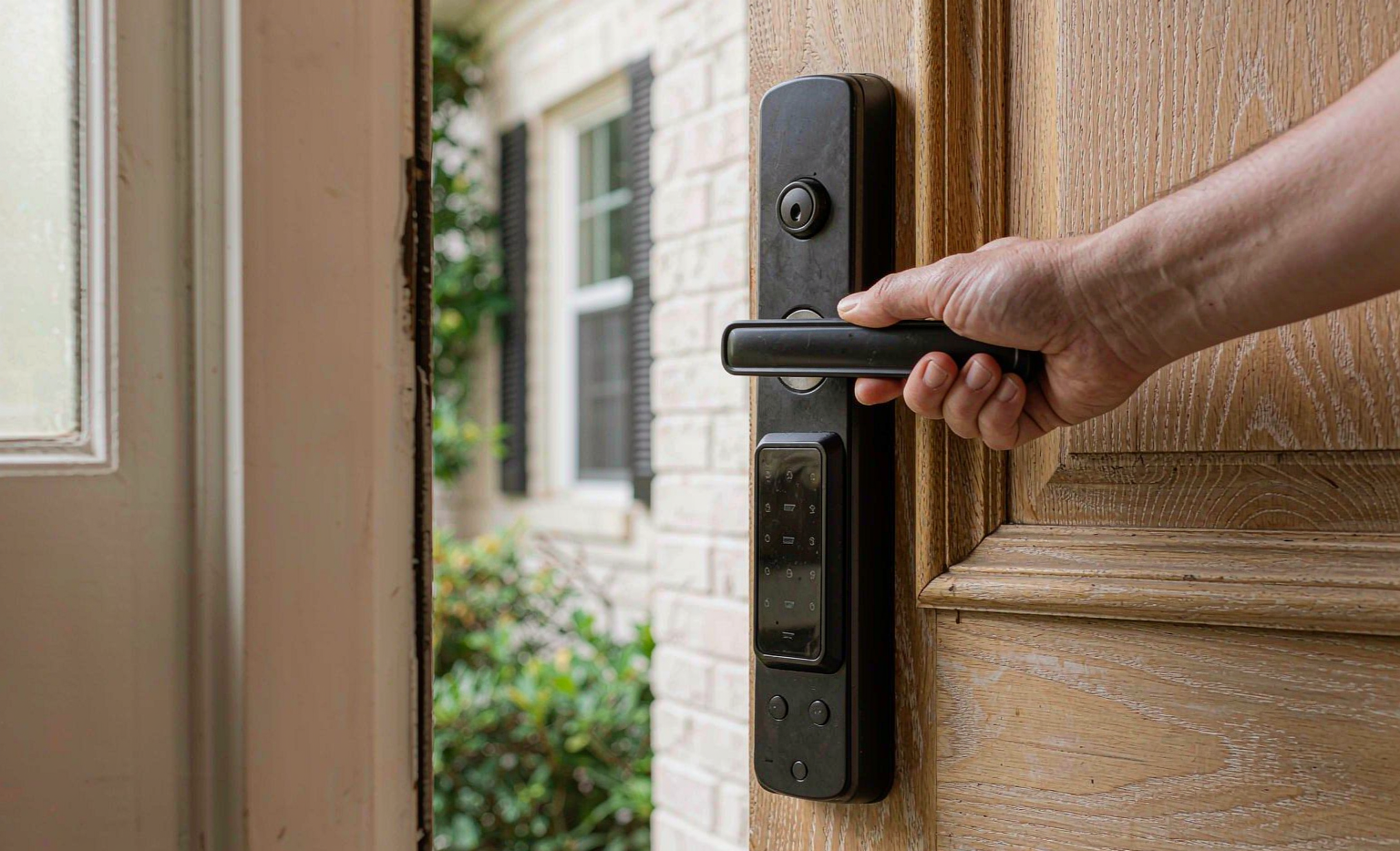
The house rules matter more than the hardware
No lock teaches judgment, so the rules stay the rules: close and lock the door the moment you’re in; message when you arrive; nobody enters the house with a stranger’s invitation; don’t tell classmates your code the way you’d tell them your favorite game level. The lock doesn’t replace any of this — it just removes the key-shaped excuse that gets in the way of all of it.
An honest boundary: what a lock does not do
A smart lock is access management, not supervision. It won’t know whether homework is done, and it’s not a substitute for the ordinary family decisions about when a child is ready to be home alone — those are judgments about the child, the neighborhood, the law where you live, and the support network around the house. What the lock does is make the arrival itself less fragile: no lost key, no hidden spare, no “was the door actually locked?” A small problem, solved small.
If you’re choosing a lock for this routine, check five things
A short filter for family locks
- Multiple access methods. At least a code plus one more method, so each person can use what suits them.
- A real mechanical key. The override path should exist and be tested, not assumed.
- Door fit. Most residential locks support a stated door-thickness range — verify your door is inside it before ordering. If in doubt, measure before you buy.
- Power you can plan around. Know the battery type and how low-battery warnings behave.
- Credential management. You should be able to add access for one person and remove it again without rekeying anything physical.
If you want the wider version of this checklist — applications, unlock methods, door compatibility — our general buyer walkthrough covers it end to end.
What we can verify from our own range
Since this is a question we get from project buyers as well as homeowners, here is the honest state of our own catalog for this use case. CaremLock’s DS01 and DS05 deadbolt smart locks are the models closest to a “first one home” routine:
- Unlock methods: fingerprint, password, IC card, and mechanical key — so a child can use a code, a card can travel in a bag, and the key stays as backup.
- Stated door fit: 35–55 mm door thickness; wood, metal, and plastic doors for DS01, wood and metal for DS05, with 60/70 mm lock-tongue options. Confirm your door preparation and backset before ordering.
- Capacity per the authorized spec: up to 100 fingerprints, 100 passwords, and 100 IC cards — comfortable room for a household plus a weekly visitor or two, with each person on their own credential.
- Power: 6 V (4× AA alkaline batteries) — ordinary batteries, easy to keep spares of.
- Versions: standalone or Tuya (Bluetooth/Wi-Fi), plus an optional door sensor. Installation drawings are provided in the product documentation.
And the boundary, stated plainly: if a feature isn’t in our published documentation, we don’t claim it here. Anything else you want to know about a specific model — ask, and we’ll answer from the spec sheet, not from marketing.
Common questions
Should the child also carry the mechanical key?
That’s a family call, but the more common approach is to keep the mechanical key as a fixed emergency backup rather than a daily item — the whole point is to stop depending on a carried key. Whatever you decide, test the full routine with your child once on a relaxed day: approach, unlock, lock, and what to do if something doesn’t work.
What happens when the battery runs low?
On models like our deadbolt locks, the lock runs on standard AA alkaline batteries and the mechanical key provides a direct override. The practical routine is simple: keep spare batteries at home, replace them on a schedule rather than on a surprise, and test the mechanical key every few months so everyone knows where it is and that it works.
Are these locks hard for grandparents or sitters to use?
The right answer is usually “give each person the method they’ll actually use.” A card or a simple code is often easier for occasional visitors than an app account. The lock supports the layer; the household assigns the method.
Planning family-home projects or distribution?
CaremLock supplies deadbolt and smart lock ranges for distributors, installers, and project buyers. Tell us your market and application — we’ll outline models, configurations, and documentation for your orders.
Or explore our deadbolt smart lock range and talk to the team.