Distance turns small signals into big ones. When an adult child lives two hours or two flights away from an aging parent, the everyday facts — the porch light is on, the mail was collected, the front door opened this morning — become the data points that make a week feel normal or worrying.
Family remote check in for elderly parents, done well, looks like this: staying informed across distance without sliding into surveillance, and without turning every quiet day into a phone call that starts with “are you okay?” The secret is separating three things that get tangled together — the resident’s independence, the family’s need for signals, and the door’s role as a neutral witness.
The two failure modes of long-distance checking
Families generally fail at this in one of two directions, and both come from the same instinct.
Too little signal. Nobody has a system, so every anomaly becomes a guess. The parent doesn’t answer at 4 p.m. — is that a problem, or is that the afternoon nap? Without normal baseline information, every missed call carries maximum weight, and the calls grow more frequent and more anxious.
Too much. Someone installs cameras, frequent calls and demanding check-ins until the parent feels investigated in their own home. The result is predictable: the resident starts managing the observers, hiding small things to avoid concern, and the relationship quietly inverts. The parent who raised the family now reports to it.
The line between the two is consent — a word that gets abstract until it’s applied, so let’s apply it. Both failure modes skip the same step: family remote check in for elderly parents works when it is designed around the resident rather than around the family’s anxiety.
What the resident consents to is the entire design
In a good arrangement, the resident is the owner of their own home and the family is a guest with agreed privileges. That framing produces a different setup from one where the family is the administrator.
Practically, it means the check-in plan starts with a conversation, not a purchase. Three questions belong in it:
- What would help you feel supported rather than watched? Often the answer is about practical help — a key that lets a helper in without the resident getting up — not about information.
- What are you comfortable sharing? Some residents are perfectly happy for a family member to see when the door was used; others find it demeaning. Both answers are legitimate, and the setup should reflect what was actually said.
- What happens when a signal looks unusual? Agree the escalation ladder in advance: who calls first, after how long, and what a “no response” actually triggers. A plan the resident helped write gets followed; a plan imposed on them gets contested.
Our article on making entry work for older parents covers the hardware side of dignity at the door, and the principle there applies here too: technology should make the resident’s daily life easier first, and the family’s information second.
The door as the least intrusive signal
The front door occupies an interesting position in this whole discussion: it is shared between the household and the outside world, it is where help arrives and departs, and it produces the kind of information families actually need — not what the person is doing, but whether daily life is running.
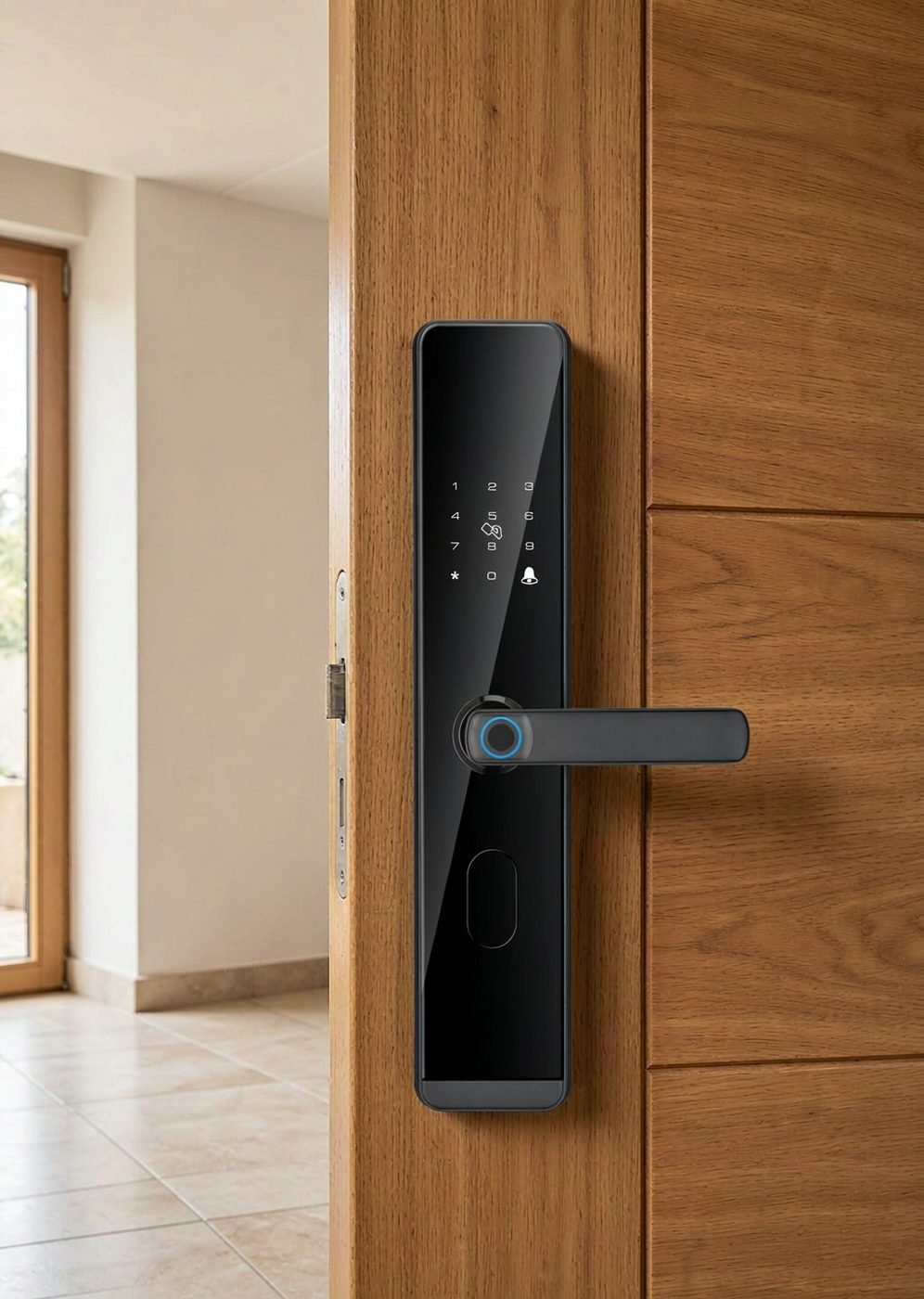
A door that can be opened with a fingerprint, a code or a card removes small frictions for the resident. On our deadbolt models DS01 and DS05, the documented access set is fingerprint, password, IC card and mechanical key, with capacity for up to 100 of each; for a parent living alone, the value is that a caregiver, an adult child or a cleaner can each hold a separate credential, so the resident never has to hand over “the” key. When a helper stops visiting, one credential is removed — no locksmith, no key left in circulation. We wrote the broader version of that arrangement in the caregiver schedule article.
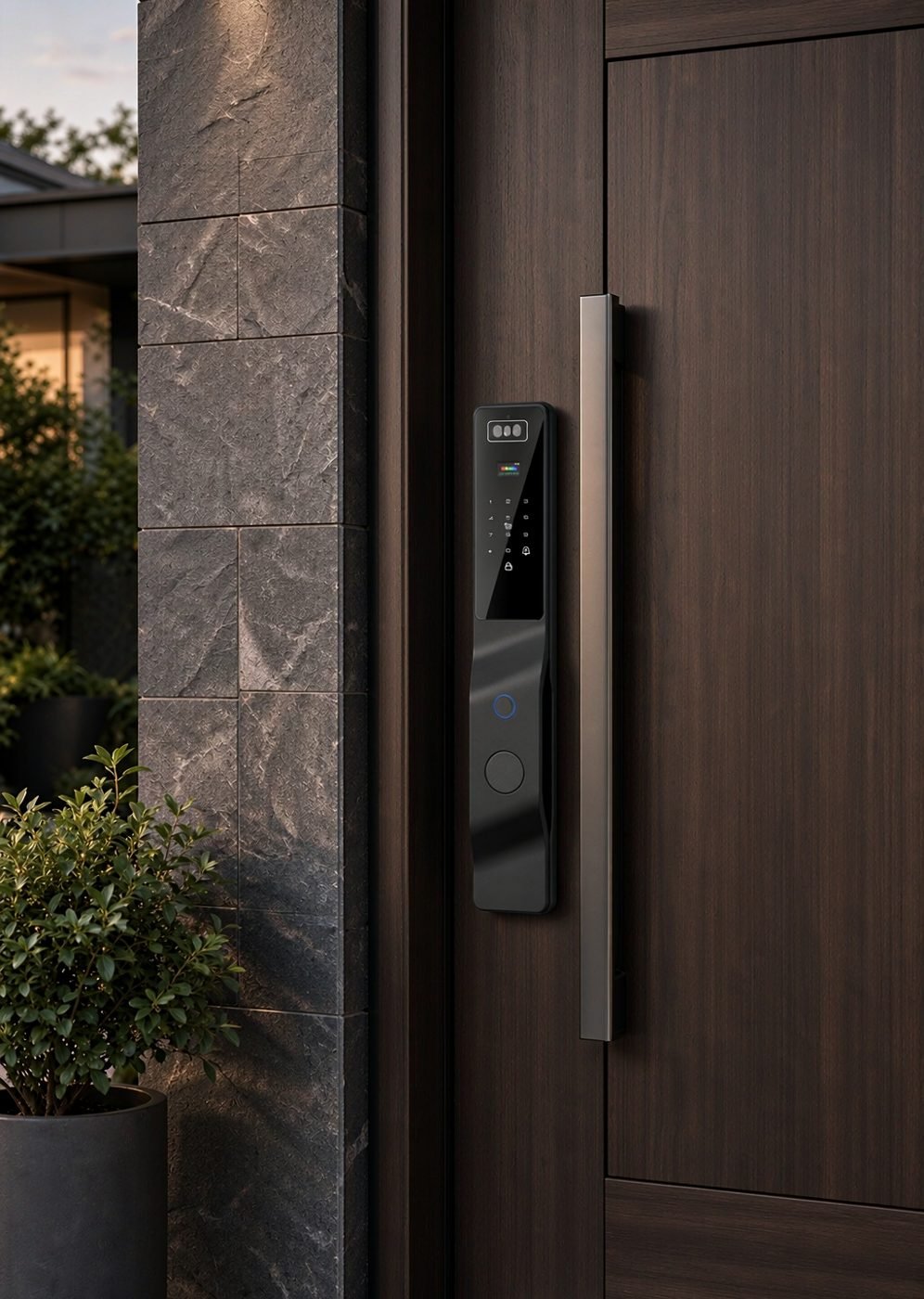
The connected dimension is a decision to make explicitly. DS01 is offered in a standalone version and in versions that connect to a platform — a wireless protocol choice made at order time, which affects what app-based management is possible afterward. If remote visibility is part of your family’s plan, that choice must be made before purchase and confirmed against the model’s documentation. And whether any app shows entry activity for your specific configuration is exactly the kind of thing to verify with the documentation rather than assume, because the honest version is: platforms differ, versions differ, and the specification sheet is the only reliable narrator.
Building a check-in rhythm that respects everyone
A long-distance family protocol
- One scheduled call, at a fixed time. Predictability does more for peace of mind than frequency. A Tuesday call that always happens beats five calls that happen nervously.
- Signals agreed in advance. If the family checks the door’s activity, agree which signals are “normal variation” and which prompt a call — and put it in writing, so nobody is judged for following the rules during a busy week.
- A local pair of eyes. One neighbor or nearby friend who knows the household and can be asked to knock if a genuinely unusual pattern appears. This is the layer that turns distant information into local action.
- A coordinated visit schedule. Whether family visits monthly or a home helper comes weekly, the resident should know who is coming and when. Surprise visits are a monitoring tactic; scheduled ones are a relationship.
- A review every season. What works changes — health, mobility and preferences evolve. The protocol should be revisited like any other household arrangement, ideally at the same time as the door’s seasonal maintenance.
When the resident needs more, not just information
The check-in conversation changes if the resident’s needs increase. At some point the family is not only watching for signals but actively organizing help — and that’s when temporary credentials become genuinely practical.
Consider a week with three different visitors: a nurse on Monday, a cleaner on Wednesday, an adult child on Friday. On models with per-person credential capacity, each visitor holds their own method and the resident keeps theirs untouched. Where the platform supports time-limited access, that structure can be tighter still — credentials that exist for the period they’re needed. If your family is planning this, check what the specific model supports: this is the kind of capability that varies by version, and the product documentation is the right place to confirm it before relying on it.
The dignity test
Before finalizing any family remote check in arrangement, run the dignity test: would the resident describe this setup the same way the family does? If the parent would say “my daughter can see that I got my mail” and the daughter would say “I monitor the door,” those are different products wearing the same hardware.
The version that lasts is the one where help is generous, information is consensual and precise, and the resident remains the person in charge of their own front door. That’s not a technical feature. It’s a decision, and it’s the one worth making first.
Remote check-in questions families ask
How often should we check in without being intrusive?
There’s no universal number, but there’s a workable principle: fewer, predictable contacts, plus a signal system that removes the need for “just checking” calls. When the door or a helper provides the baseline, the calls can return to being conversations instead of inspections.
Can we see when our parent’s door opens?
It depends entirely on the model, version and platform configuration — connected versions offer app-based management, but what is visible and to whom varies. The safe assumption is none until the documentation says otherwise, and any arrangement that includes it should be agreed with the resident before it is switched on. Where it exists and is agreed, it works best as a reassurance signal for unusual patterns, not as a live feed of daily movements.
What if the parent refuses any connected features?
Then the household can still get most of the benefit. A lock with separate credentials gives helpers their own access, the resident keeps a method they find easy, and the family’s check-in rhythm carries the rest. The resident’s preference is not an obstacle to safety; it’s a boundary around it, and the plan should be built to respect it.
Supporting families who live at a distance?
CaremLock supplies deadbolt and room-door ranges to distributors, installers and care-sector project buyers. Tell us the household or program profile — we will outline the models, credential capacity and documented options that fit.
Or explore the DS01 deadbolt model and contact the team.