Nobody replaces a working lock for fun. An entry change happens because something else changed first — a daily friction, a shift in the family, a property transition, or a project standard that put the door on a list. The upgrade conversation gets easier the moment the seller names that something.
This is written for distributors, showroom teams and project sellers: how to find the real trigger, frame the change around it, and stay inside what the documentation actually supports while doing it.
The four honest triggers
Across residential and light-commercial sales, entry hardware gets replaced for four reasons, and “the old one broke” is only one of them. Friction is the first: the door has become annoying. Family change is the second: new people, new schedules, new needs. Property change is the third: a rental turns over, a unit converts, a building changes use. Project standard is the fourth: a development or operator decides on a specification, and individual preferences stop mattering.
A seller who can name which trigger is in play stops guessing. The trigger determines the model family, the platform conversation and even the timing — because a friction upgrade and a specification upgrade move on completely different clocks.
Friction: the trigger customers can feel
Friction is the easiest upgrade story because the customer already knows it by heart. They just do not call it a trigger; they say “the door sticks” or “my wife has to put the bags down.” Ask one question — which moment of the day is worst? — and the pain names itself: the school run, the grocery haul, the late shift, the hands-full arrival we described in getting in with your hands full.
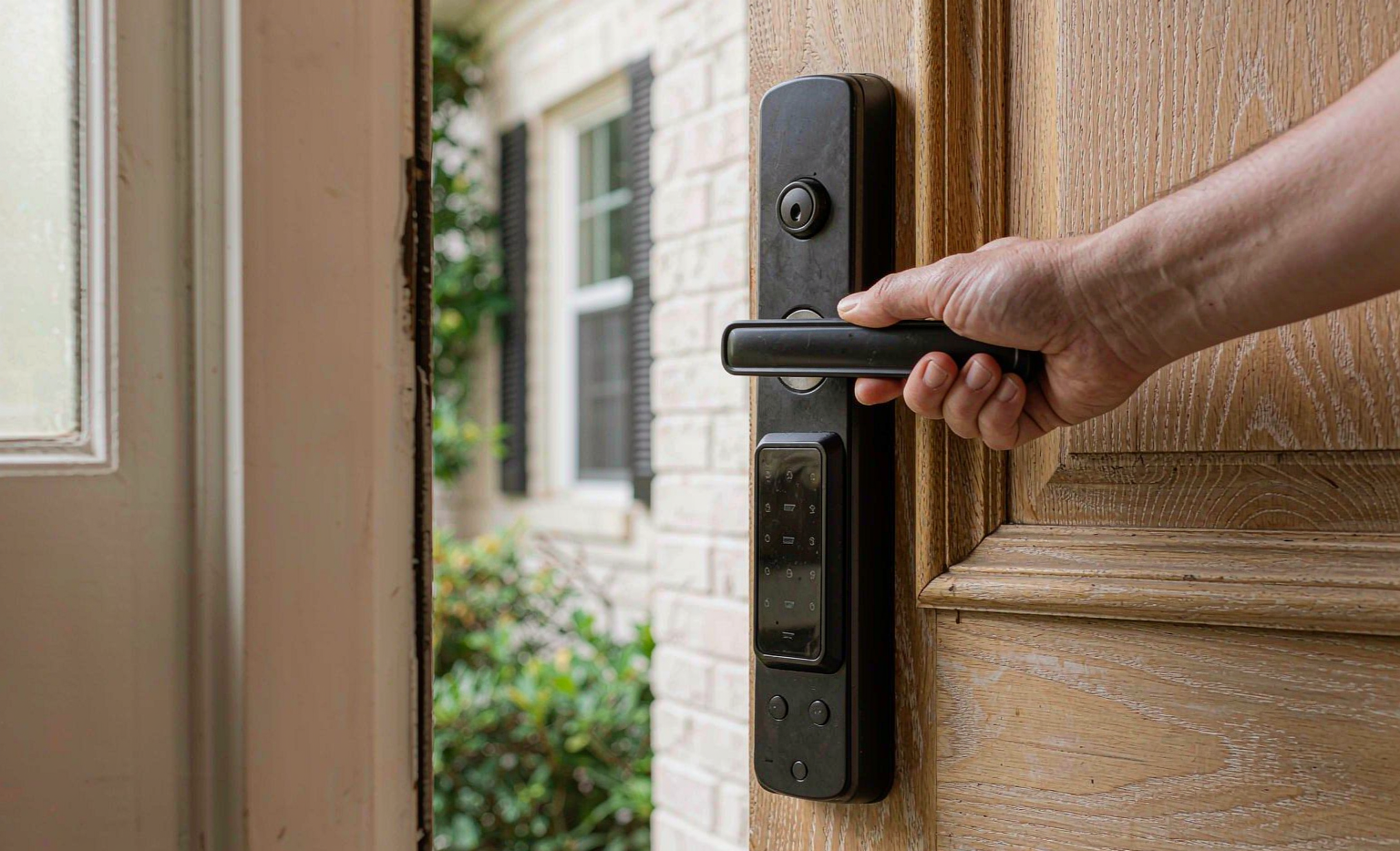
On the hardware side, friction stories map neatly to mechanism class. The DDA2 one-grip smart lock documents a grip-and-pull motion — one hand, one movement — and the fully automatic class removes even that. The sale is not “buy this lock”; it is “this door will stop taking two hands.”
Family change: the invisible trigger
Some triggers arrive without a complaint. A new baby changes what “quiet entry” means. An aging parent moves in, and suddenly a care circle needs access that does not involve copies of a key. A teenager starts coming home after the adults are asleep, and the door needs to open reliably without waking the house.
These customers often walk into a store without knowing they are in the market. The seller’s job is not to manufacture the problem but to reflect it: “Is this door used the same way it was a year ago?” Family-change upgrades sell on the strength of one idea — access should adapt when the household does, without a locksmith or a key exchange every time.
Property change: when the unit decides
Rental turnover, short-stay conversion, a home office carved out of a spare room — property changes generate hardware decisions whether or not anyone wants to make them. The constraint is operational: every change of occupant should be an access change, not an errand.
Here the catalog splits by door and by rhythm. Aluminum-framed and narrow-profile entrances point to the LK0161 waterproof fingerprint model; interior room doors point to the DDZ17 with its documented temporary password support; glass entries point to the A20. For portfolio-level mapping, the routes are collected in CaremLock’s solutions overview.
Project standard: when the spec arrives first
The fourth trigger does not belong to the resident at all. A developer, operator or integrator writes a standard — a model family, a platform, a credential policy — and the sale becomes a documentation exercise. The winner is usually decided before any conversation about preferences: it is whoever can answer the technical questions cleanly and on time.
Distributors who want to be on that list should prepare the way we describe in the OEM/ODM guide: know the documented specifications, know the platform versions, and keep the paperwork ready. In specification selling, preparation reads as competence.
The frame, in three questions
Find the trigger before showing the catalog
- What’s annoying about the door right now? The answer locates friction and hands the seller the customer’s own language.
- Who uses it daily, and who visits? This separates a household decision from a project decision and previews the credential conversation.
- What changes in the next year? A move, a renovation, a new tenant, a new baby — the future is where most upgrades actually live.
Only after those three answers does the model conversation make sense: door type first, mechanism class second, platform version third. Sellers who follow that order describe the upgrade as a consequence of the customer’s life rather than a preference of the catalog. That ordering is the discipline behind smart lock upgrade selling.
Staying honest while selling
An upgrade sale earns its margin in the follow-through. Documented specifications go on the quote; questions about timing, terms or approvals go to written confirmation, not to a confident guess at the counter. The fastest way to lose a project is a number someone invented to keep the conversation moving.
It also helps to know when the honest answer is “not yet.” If the current lock meets the household’s needs and the door is compatible, waiting is a real option — and saying so builds the trust that brings the customer back when the trigger finally arrives. The self-checks in a home entry audit are a good script for that conversation.

Questions from distributors
How do we create urgency without pressure?
Use the customer’s own trigger. Friction that has been described out loud creates its own urgency; family and property changes come with dates already attached. A working lock is not an emergency, so frame the timing honestly — before the renovation, before the new tenancy, before winter — rather than inventing a deadline.
The customer says the old lock still works. What then?
Agree with them. A lock that meets the need is not broken, and a premature sale costs more in returns and reputation than it earns. Then ask the three framing questions; if a real trigger surfaces, it will carry the conversation. If it does not, ask to be the call when it does.
When is upgrading the wrong advice?
When the current hardware fits the door and the household, when the door’s preparation does not match the candidate model, or when the trigger is a feature the customer will never use. Saying “this is not your upgrade” once outweighs a dozen enthusiastic recommendations — and it is memorable for exactly the right reason.
Equipping a team to sell upgrades honestly?
CaremLock supplies documented deadbolt, one-grip and interior ranges across the triggers above, with model data your team can quote with confidence. Tell us which customer segments your market mixes.
Or explore the product range and contact the team.