
A door is usually designed for one imaginary body: someone of average height, with two free hands, a confident grip and eyes that find the keyhole in the dark. Everyone else meets the door on its terms — the grandmother whose hands have lost strength, the parent carrying a toddler and two bags, the visitor leaning on a cane.
Accessible door entry design is often treated as a specialist subject for a few households and a few projects. In practice, reach, grip, force and feedback are the same four things every door asks of every person who uses it. Get them right, and the entrance stops being a small daily test for everyone who crosses it.
Three demands a doorway makes
Strip entry down to the moment it happens and the door asks for a short sequence: reach the control, grip it, apply force, and receive confirmation that the door accepted you. A door can pass or fail each demand independently. A handle at a comfortable height can still be a round knob that needs a full wrist turn. A lever can be easy to pull and still sit beside a step that makes the whole motion awkward.
Breaking entry into these separate demands is how you inspect a door without guessing. It also separates what a lock can fix from what the building must fix. A threshold that is too high is not a lock problem — but it is part of the same journey, and the moment someone specifies new entry hardware is often the moment anyone looks closely at the door at all.
Reach: where handles and readers sit
For most adults and children, the comfortable band for a door control runs roughly from waist to chest height. It is also the band that stops working when the person using the door is shorter, taller, seated, or carrying something that occupies one arm. Hardware that keeps every control — handle, reader, keypad — inside that band removes a surprising amount of daily effort. Readers placed at handle height, rather than above or below it, let a fingerprint or a card tap and a hand on the handle happen as one movement instead of two.
Door hardware catalogs rarely frame the choice this way, but the physical differences between handle types are exactly this kind of detail. The trade-offs are set out well in this comparison of knob, lever and push-pull handles, which is worth reading before assuming a familiar shape is a neutral choice.
Grip and force: the mechanics people feel
The two classic mechanisms ask different things of a hand. A round knob asks the hand to close around a small circumference and rotate the wrist. A lever handle asks for a downward push or lift, which most hands can deliver from above, below or the side, with a loose grip or a closed fist.
Our semi-automatic one-grip series takes the idea a step further by changing the sequence itself. On the DDA2 one-grip smart lock, entry is a grip-and-pull: hold the handle and pull, rather than grip, turn, push and then pull. One compound motion replaces a four-step one. DDA3, from the same series, follows the same semi-automatic one-grip class.
Force is the quietest of the demands. A well-fitted door opens with a light touch; the same door in humid weather, with a swollen frame or a misaligned strike, can demand a shoulder. That variation matters most to people whose strength is limited and cannot adapt — which is why alignment and fit deserve attention before any decision about electronics.
Credentials that ask less of a body
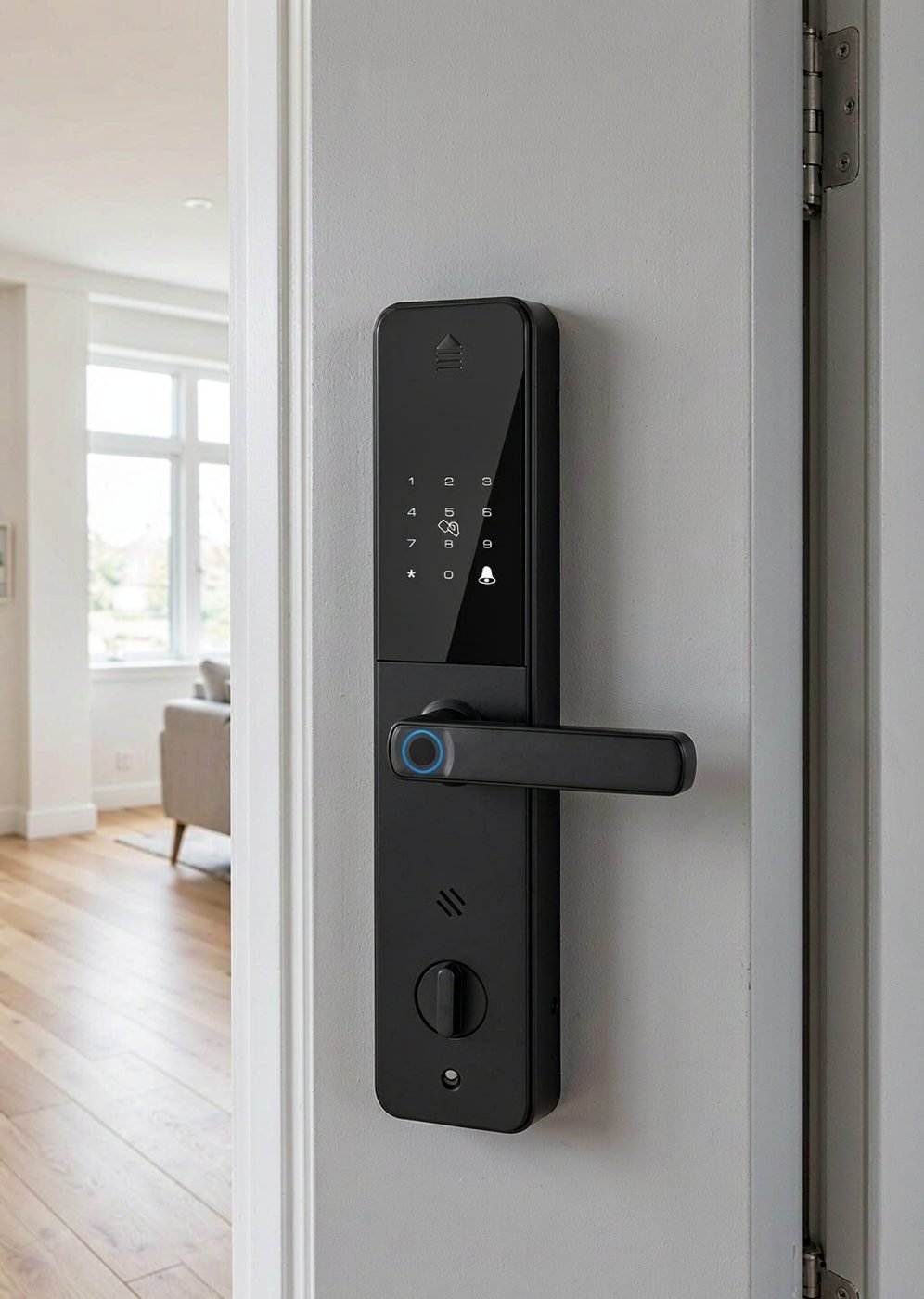
Carrying a key, finding it, and turning a small cylinder in the dark is a task of fine motor control, delivered at the exact moment hands tend to be fullest. The alternative methods documented on our deadbolt models spread that demand differently: a finger rests on a reader; a card is held near or tapped; a code is typed at a keypad; the mechanical key is reserved as the backup layer. Each person can hold their own method, so the household member who finds a keyway difficult can use the method that requires the least precision.
Capacity is not the obstacle to running it this way. DS01 and DS05 each document capacity for up to 100 fingerprints, 100 passwords and 100 IC cards — far more than a household needs, which means every member can hold a credential of their own instead of sharing one that only suits the fastest pair of hands.
The same door serves helpers and visitors
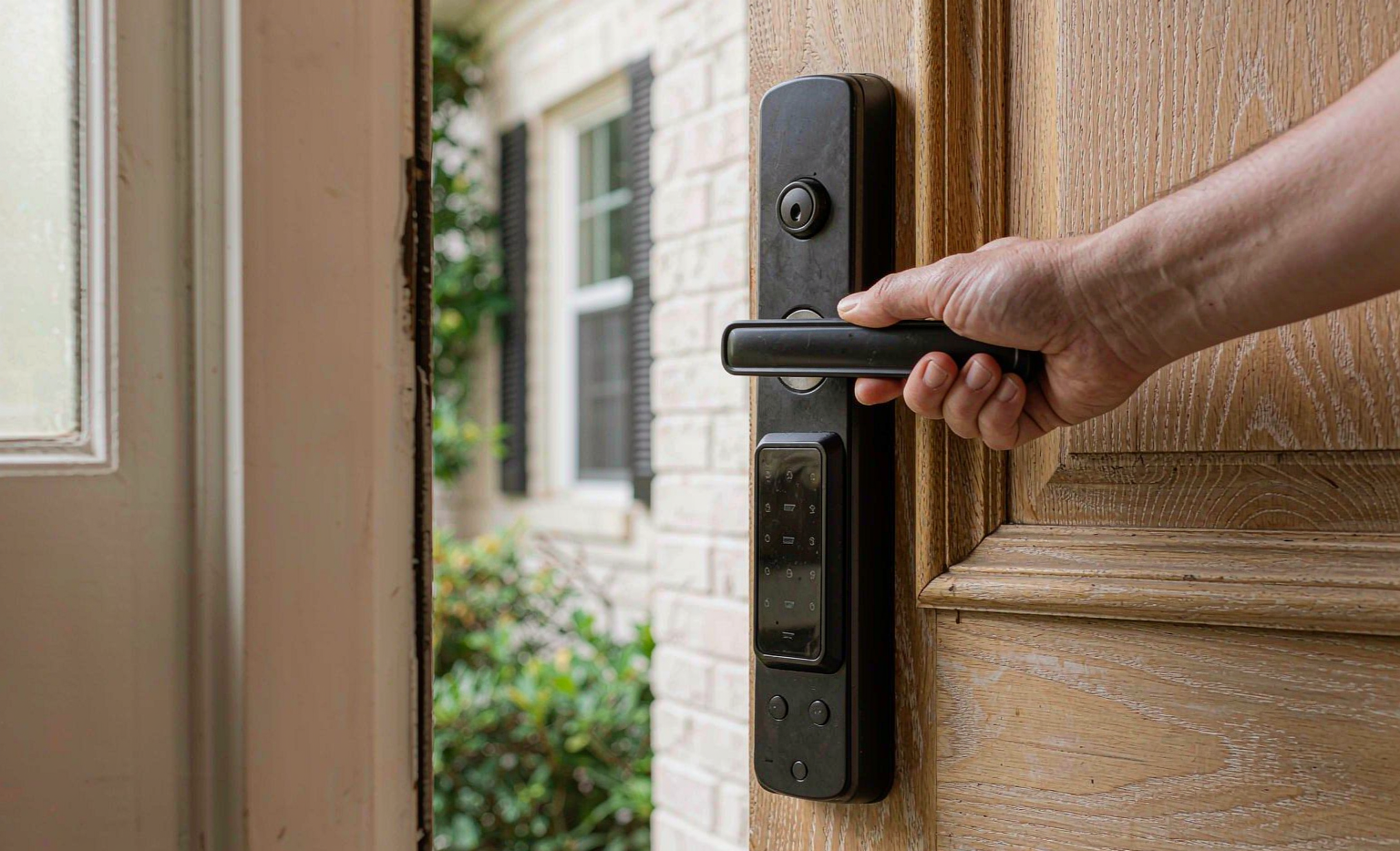
Entry design for different bodies is not only about the resident. A home-care professional arrives with equipment and bags. A grandparent visiting weekly should not have to relearn a new motion every visit. A delivery visitor needs to understand the door in five seconds, without an app and without training.
Two capabilities matter disproportionately here. The first is a method that works without a phone: codes, cards and fingerprints all qualify, while app-only access does not serve a visitor who will never install anything. The second is feedback that can be perceived — a light, a tone, a spoken prompt. Our deadbolt models document voice prompts in Chinese, English, Spanish and Portuguese, which also crosses the language gap in households where the visitor and the resident do not share a first language. We covered the household side of this in more depth in making entry work for older hands and in designing for arrivals with full hands.
Beyond the lock: light, contrast and the path
Hardware is only one layer of an accessible entrance. The others belong to the building: an approach that is level and firm, a threshold that can be crossed without a lift, light that reveals the reader instead of glaring off its surface, and contrast between the door, the frame and the hardware so the edges of things are visible in dim light. None of these is a lock specification. But a lock decision is a good moment to raise them, because it is usually the moment someone stands at the door with a critical eye.
A short brief before you choose
Accessible door entry design: questions to settle before ordering
- Can the daily unlock method be used one-handed, without looking down at a small target?
- Does at least one method require no grip strength at all — a fingerprint, a card, a code?
- Does the method work without a phone, for the people who will never install an app?
- How does the door confirm that entry was accepted, for someone who cannot see a small light?
- Is the mechanical key kept as a tested backup, and does everyone who might need it know where it is?
- Has the full motion — arrive, unlock, open, pass through, close, lock — been tried by the person who will use it daily, in the conditions they will meet it?
Questions we hear about accessible entry
Does a smart lock mean nobody has to turn a key again?
For daily use, the mechanical key can step back into a backup role, which is exactly where it is most useful. It is worth keeping the key workable rather than ceremonial: a cylinder that has not been turned in a long time is worth testing while nothing depends on it.
What exactly is a “one-grip” entry?
It describes the motion, not the electronics: the handle is gripped and pulled in one continuous action, with the lock’s assistance handling the rest. On our DDA2 and DDA3 semi-automatic models, that removes the separate grip-turn-push sequence that many hands find awkward.
Is accessible door entry design only about limited mobility?
No, and that is the point. Every improvement described here — lower effort, fewer precise movements, clearer feedback — is also what a person with two sleeping children in their arms needs at eleven at night. Designing for the edges of ability reliably produces doors that work better in the middle.
Specifying entry hardware for accessible housing?
CaremLock supplies deadbolt and one-grip smart locks for distributors, installers and project buyers working on accessible and later-life housing. Tell us the doors and the residents’ needs, and we will walk through the documented fit of the range.
Or explore the semi-automatic one-grip range and contact the team.